A one-square-mile oceanfront village where St. Regis and Ritz-Carlton compete for the same address — and where scarcity, not scale, sets the price.
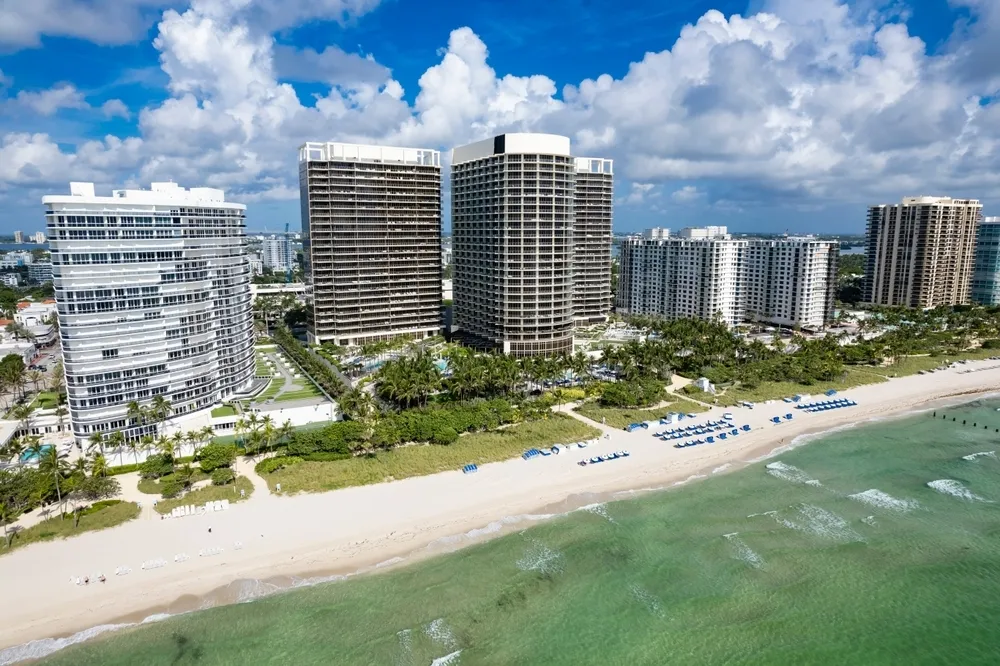
Bal Harbour has just 14 buildings on a one-square-mile footprint, anchored by the Bal Harbour Shops at one end and two competing hospitality brands at the other — the three-tower St. Regis complex and the Ritz-Carlton-branded One Bal Harbour. No new tower broke ground here for over a decade until Rivage Bal Harbour, the village's first new construction since 2016. That scarcity is why the village posts some of the highest per-square-foot prices in Florida: $1,695/SF average asking, $1,365/SF average closed, per MiamiRE/Bridge MLS.
A curated selection of standout buildings personally chosen by Haute Residence based on design, location, service, reputation, residence quality, and overall luxury positioning. This is editorial judgment, not an algorithm or a ranking.
The complete Haute Building Index™ for Bal Harbour — every profiled building, from 1970s–80s classic towers to the current branded new-development wave. The Haute List above is Haute Residence's curated selection within this database, not a replacement for it.
Bal Harbour is one of the few markets in South Florida where two global hospitality operators sit within walking distance of each other. The St. Regis Bal Harbour Resort brought full Marriott St. Regis butler service to the village in 2011 across its Central, North and South towers. One Bal Harbour has operated as a Ritz-Carlton-branded address since 2007, pairing full resort service with 4.5 acres of beachfront grounds. Between them, the two brands anchor the top of the village's pricing — and Rivage's arrival is the first time in over a decade a project has tried to compete with that service standard on pure architecture and scale instead of a hotel name.
Fourteen buildings on a one-square-mile footprint span 1970s beachfront classics (Balmoral, Bal Harbour 101) through the branded-hospitality towers of the 2000s and 2010s (St. Regis, One Bal Harbour) to Rivage, the village's newest arrival. See every profiled building, current listing counts included, in All Buildings above ↑.
Both markets sit directly on the Atlantic a few minutes apart, but they trade on opposite scales. Bal Harbour is deliberately small — 14 buildings, low-rise zoning, and the Bal Harbour Shops as its only commercial district — which is exactly what keeps its per-square-foot prices among the highest in Florida. Sunny Isles Beach is the opposite bet: a dense corridor of automotive- and hospitality-branded supertall towers (Bentley, Porsche, Armani/Casa, St. Regis) competing on scale, amenity spectacle and volume of new construction. A buyer choosing Bal Harbour is buying scarcity and village quiet; a buyer choosing Sunny Isles is buying the newest, biggest branded tower on the market.
Sunny Isles competes on scale; Bal Harbour competes on scarcity.
Fourteen buildings on one square mile means Bal Harbour cannot out-build its neighbors — so it doesn't try. Rivage's arrival after more than a decade without new construction isn't a sign the market is opening up; it's a reminder of how rare a new address here actually is, and why the village keeps posting some of the highest per-square-foot prices in the state.
HL Real Estate Group advisors work across Bal Harbour's branded-tower and legacy condo market, with building-level knowledge of current inventory, recent sales, and private opportunities.
Scarcity. Fourteen buildings, low-density zoning and almost no developable land mean supply cannot grow, while the Shops, the beach path and the village's service culture keep demand deep. Scarce markets hold value.
Rivage Bal Harbour is the village's first new oceanfront condominium in more than a decade — large residences, private amenities and immediate beach frontage. We cover it in detail on its project page.
Yes — it functions as a quiet residential village with A-rated schools nearby, private security and the Shops as its town center, while Miami's business districts are 25 minutes away.