Waldorf Astoria Miami vs. Waldorf Astoria Sarasota: Same Brand, Two Different Bets
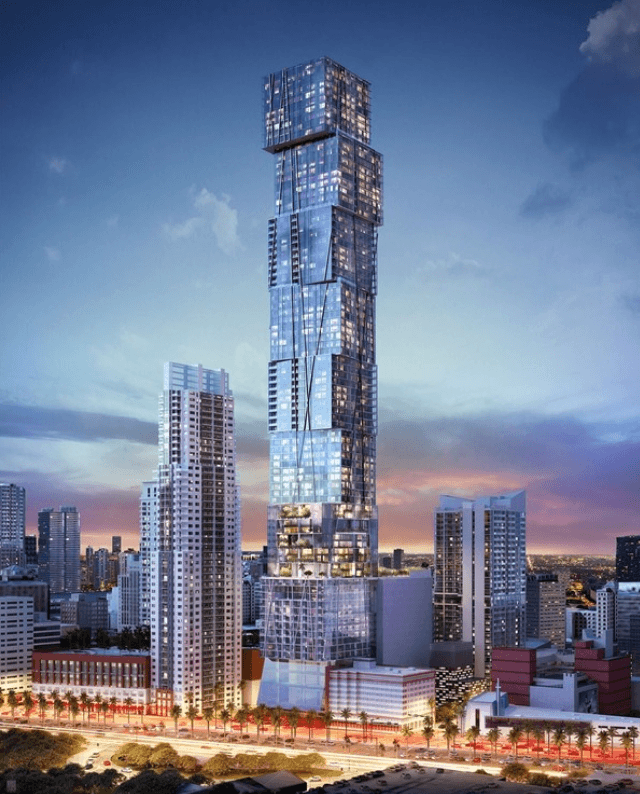
Waldorf Astoria Residences Miami is a 100-story, 1,049-foot supertall — Florida’s first — with 387 residences priced from $3.15 million and delivery targeted for 2028. Waldorf Astoria Residences Sarasota is an 18-story, 86-residence boutique tower from $2.2 million, targeting 2029. Same flag, opposite theses: skyline dominance versus small-market scarcity.
Hilton’s most storied luxury brand is now underwriting two very different Florida propositions. In downtown Miami, PMG and partners are past the halfway mark on the tower that will redefine the skyline. In downtown Sarasota, Jebcore Companies and WMG Development launched sales in January 2026 for a residential-only building a fraction of the size.
For buyers weighing the two — and many branded-residence buyers now shop across markets — the decision is less about the brand, which is identical, than about the bet underneath it. Our complete guide to branded residences in South Florida frames how these programs create value; here is how the two Waldorfs split.
What does each Waldorf Astoria cost?
Miami starts at $3.15 million, with Sky Collection and penthouse residences reaching $50 million, per Miami Real Group (June 2026). Sarasota starts at $2.2 million for one-bedrooms, with two-bedrooms from $2.5 million, three-bedrooms from $4 million, and penthouses up to $25 million, per Nest Group (August 2026).
The gap narrows quickly above entry level. Sarasota’s three-bedroom range of $4 million to $8 million-plus overlaps squarely with Miami’s mid-tower inventory, meaning a buyer with a $5 million budget genuinely faces a market choice, not a price choice.
Availability tells its own story. Miami was more than 90 percent sold as of late 2025, per Florida YIMBY, with remaining inventory concentrated in the upper Sky and Penthouse collections. Sarasota, which commenced sales January 27, 2026, per Hilton’s announcement, offers the full spread of its 86 floor plans. Whichever tower you pursue, understand the escrow and deposit mechanics first — our guide to preconstruction deposits covers what Florida law protects.
How do the two towers differ in scale and setting?
Miami is a vertical city: 100 stories, 1,049 feet, 387 residences plus a 205-room Waldorf Astoria hotel, rising as nine spiraling glass cubes at 300 Biscayne Boulevard (Florida YIMBY, December 2025). Sarasota is a boutique: 18 residential-only stories and 86 residences at Main Street and Pineapple Avenue.
The Miami tower — designed by Sieger Suarez Architects with Carlos Ott, interiors by BAMO — integrates full hotel operations, so owners live above Peacock Alley and a working five-star property. Its Bank OZK and Related Fund Management construction loan of $668 million was characterized as the largest ever secured for a residential condominium in Florida, per Miami Real Group.
Sarasota inverts the formula: no hotel, just residences with hotel-grade service. Owners receive Hilton Honors Diamond status and preferred rates across Waldorf Astoria properties worldwide, per Hilton (January 2026). The ODP Architecture & Design building, with Workshop/APD interiors, carries more than 60,000 square feet of interior amenities — its own Peacock Alley lounge, spa, golf simulator, theater — crowned by a 25,000-square-foot rooftop garden with a resort pool. Fourteen-foot ceilings across one-to-five-bedroom plans give it a scale of residence, if not of tower, that Miami’s mid-stack units cannot match.
Which delivers first — and which is further de-risked?
Miami delivers first and carries far less execution risk. The superstructure passed the 50th floor in December 2025, advancing roughly one floor every ten days toward a 2028 delivery, per Florida YIMBY. Sarasota anticipates a late-2026 construction start and 2029 completion, per Hilton and Nest Group (2026).
A tower past its halfway pour with a signed general contractor — John Moriarty & Associates, in Miami’s case — and more than 90 percent of units sold sits at the low end of the completion-risk spectrum. Sarasota is earlier in the arc: sales launched in January 2026 and vertical work had not yet begun as of its August 2026 coverage, which is normal for a project of its vintage but leaves more milestones ahead.
Buyers comparing timelines across the region can place both towers in context with our South Florida luxury condo delivery calendar, 2026–2030, and our framework on how to read completion risk in preconstruction explains why groundbreaking, financing, and pre-sale thresholds matter more than renderings.
Which market has more upside — downtown Miami or Sarasota?
Miami offers depth: a global buyer pool, a proven ultra-luxury resale market, and a supertall that will be the tallest building in the city — a one-of-one asset. Sarasota offers scarcity: the first Waldorf Astoria in a Gulf Coast cultural capital where nothing comparable exists, at a lower entry basis.
The Miami bet is liquidity and trophy status. When the skyline’s tallest tower carries the Waldorf flag, its residences become a reference asset — the comparable everything else trades against. The tower’s sales velocity, north of 90 percent before topping off, suggests the market has already voted; the full history is in our complete guide to Waldorf Astoria Residences Miami.
The Sarasota bet is being early. Downtown Sarasota has the arts institutions, the Gulf beaches, and the wealth migration, but has never had a global-flag branded residence at this level. If the brand converts that gap into pricing power, early buyers capture the re-rating. The risk is symmetrical: a smaller resale market with fewer data points means exits depend more heavily on the brand thesis playing out.
Which buyer is each Waldorf Astoria for?
Miami suits the globally mobile buyer who wants hotel living, skyline-defining trophy value, and near-term 2028 delivery — and who can clear a $3.15 million-plus basis. Sarasota suits the primary or seasonal Gulf Coast resident who wants brand-backed service at a lower entry, without a hotel lobby between them and home.
The hotel question is the honest fork in the road. Some owners want room service, a managed rental-adjacent ecosystem, and the energy of 205 guest rooms below; others specifically do not. Sarasota’s residential-only format, with guest suites for visitors and Diamond-status travel benefits, delivers the brand without the traffic.
Frequently Asked Questions
How tall will Waldorf Astoria Residences Miami be?
The tower will rise 100 stories to 1,049 feet at 300 Biscayne Boulevard, making it Florida’s first supertall and the tallest building in Miami, per Florida YIMBY (December 2025). Its design stacks nine offset glass cubes in a spiraling formation.
How much does a residence at Waldorf Astoria Miami cost?
Available residences started at $3.15 million as of June 2026, per Miami Real Group, with Sky Collection and penthouse units priced up to roughly $50 million. The building was more than 90 percent sold, so remaining inventory skews to the upper floors.
How much does Waldorf Astoria Sarasota cost?
One-bedrooms start at $2.2 million, two-bedrooms range from $2.5 million to $4.5 million, three-bedrooms from $4 million to $8 million-plus, and penthouses reach up to $25 million, per Nest Group (August 2026). Sales are led by Michael Saunders & Company.
When do the two towers deliver?
Miami targets 2028, with the superstructure past the 50th floor as of December 2025 and topping off anticipated in late 2026 or early 2027. Sarasota anticipates a late-2026 construction start with completion expected in 2029, per Hilton’s January 2026 announcement.
Does Waldorf Astoria Sarasota include a hotel?
No. Sarasota is a residential-only building of 86 residences — there is no hotel component. Owners still receive Hilton Honors Diamond status, preferred rates at Waldorf Astoria properties worldwide, and hotel-style services, including the brand’s signature Peacock Alley lounge.
Who is developing each project?
Miami is led by Property Markets Group (PMG) with Greybrook, Mohari Hospitality, S2 Development, and Hilton, per Florida YIMBY. Sarasota is developed by Jebcore Companies and WMG Development in partnership with Hilton.
Which is the better investment?
Miami offers a deeper resale market, near-term delivery, and one-of-one trophy status; Sarasota offers a lower basis and first-mover scarcity in an emerging luxury market. Risk-averse capital generally favors Miami’s construction progress; thesis-driven capital may prefer Sarasota’s earlier entry point.
Are deposits structured the same way in both projects?
Deposit schedules are set project by project and released through each sales gallery, so confirm the current structure and escrow terms in writing before reserving. Florida preconstruction deposits carry specific statutory protections and real differences between projects.
Two towers, one flag, and two very different ways to own it. Compare both Waldorfs against every major project rising from Miami to the Gulf Coast at Haute Residence New Developments.