The Most Beautiful Primary Bathrooms in South Florida New Developments
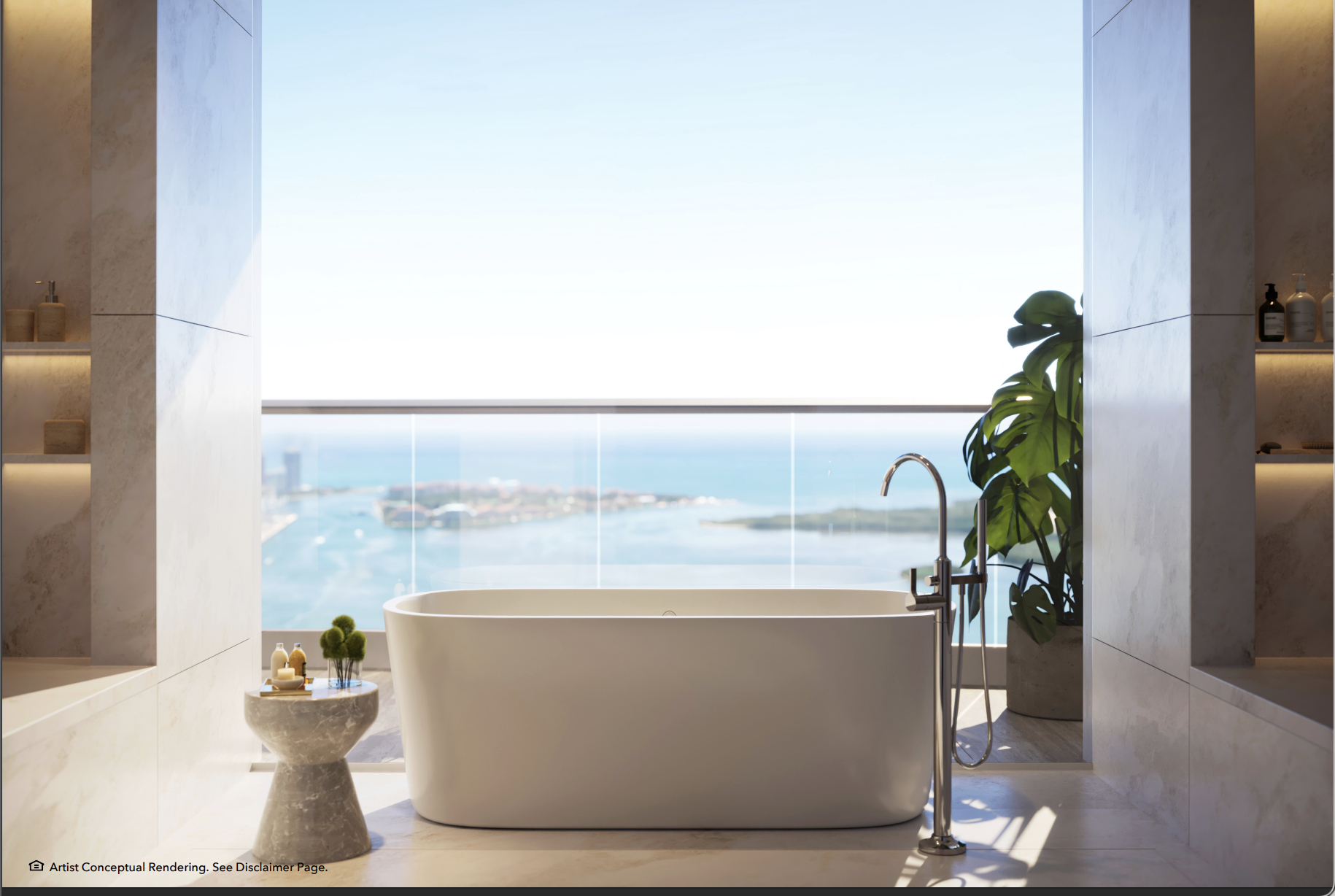
In the most considered luxury residences, the primary bathroom has become something else entirely. Here are five projects that understand why.
Ask a serious luxury buyer what they remember most about a residence — not the view, not the kitchen, not the lobby — and the answer, more often than not, is the bathroom.
Not because it is the largest room. Because it is the most personal. It is where the day begins and ends. Where the quality of stone, light, and silence either delivers on a building’s promise or quietly exposes its limits.
In South Florida’s most significant new developments, the primary bathroom has undergone a genuine transformation. The era of the oversized builder bath — double sinks, a Jacuzzi tub, beige travertine — is long gone. What has replaced it is something closer to a private spa: a room conceived with the rigor of a wellness architect and the sensibility of a great hotelier.
The five projects below represent the current high-water mark for luxury condo bathrooms in Miami and across the South Florida coast. Each brings a different interpretation of the same ambition. Each is worth studying closely.
The Residences at Mandarin Oriental, Miami
The Quiet Room
The Mandarin Oriental has spent half a century perfecting the grammar of wellness. Its spas are among the most copied in the hospitality world. What they have never been able to fully replicate, anywhere, is the Mandarin’s particular quality of stillness — the sense that the room itself is asking you to slow down.
That quality arrives at The Residences at Mandarin Oriental, Miami, and it arrives in the bathroom first.
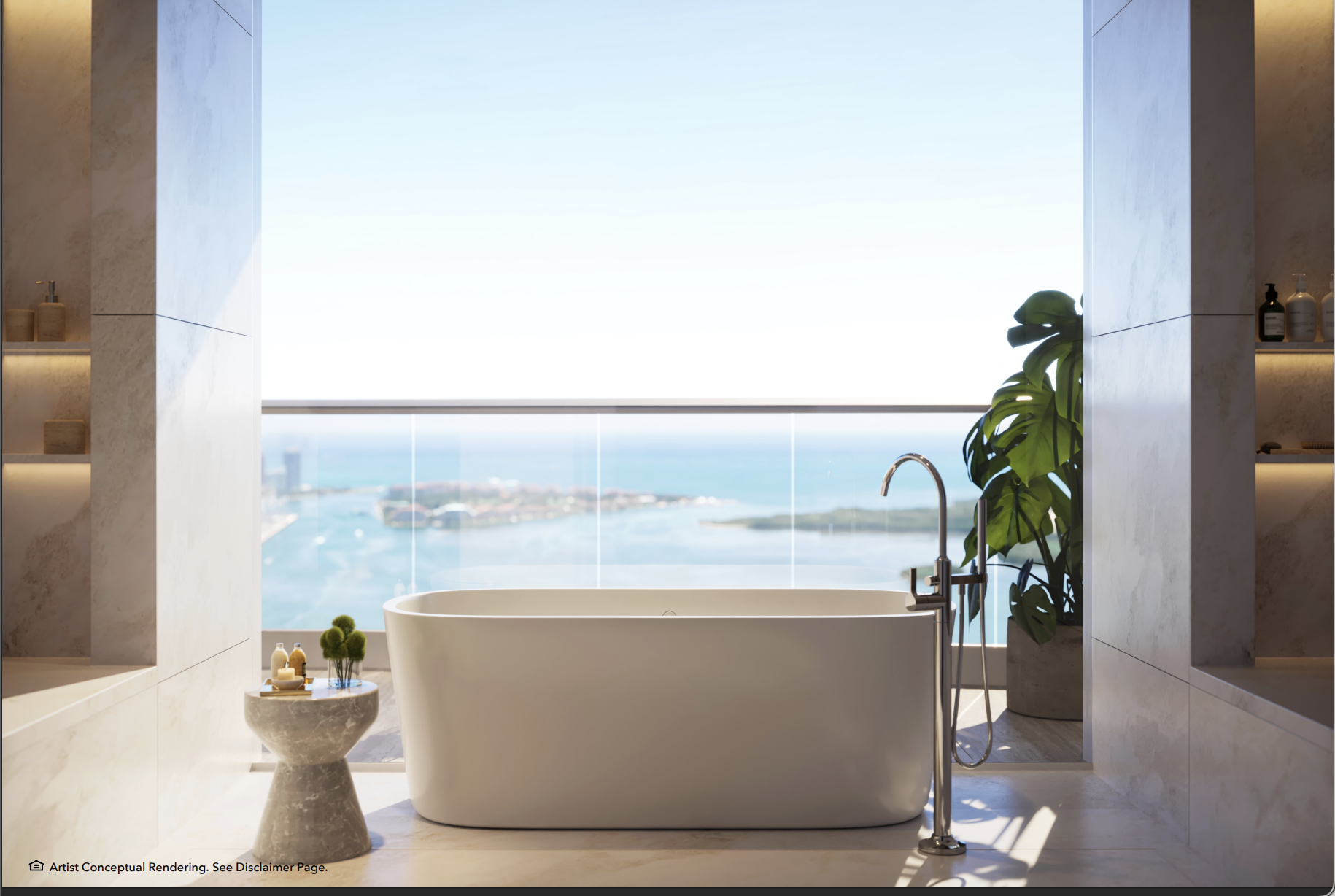
The material palette is deliberate and calm: warm stone with soft veining, surfaces that reward attention rather than demand it. Freestanding soaking tubs are positioned with the same consideration a set designer would bring to a scene. The relationship between the tub and the view is not accidental. Steam showers with rainfall heads extend a hospitality tradition into the private sphere. Natural light is treated as a material — manipulated by window placement, mirror positioning, and layered ambient circuits that shift through the day.
What separates a Mandarin Oriental bathroom from a merely beautiful bathroom is philosophy. These rooms are built around the experience of being in them, not the experience of photographing them. That is a meaningful distinction.
Four Seasons Private Residences Coconut Grove
Warmth Without Weight
Coconut Grove has always been Miami’s counterpoint — slower, greener, less interested in spectacle. Four Seasons Private Residences Coconut Grove honors that character in every material decision, and nowhere more fluently than in the primary bathroom.
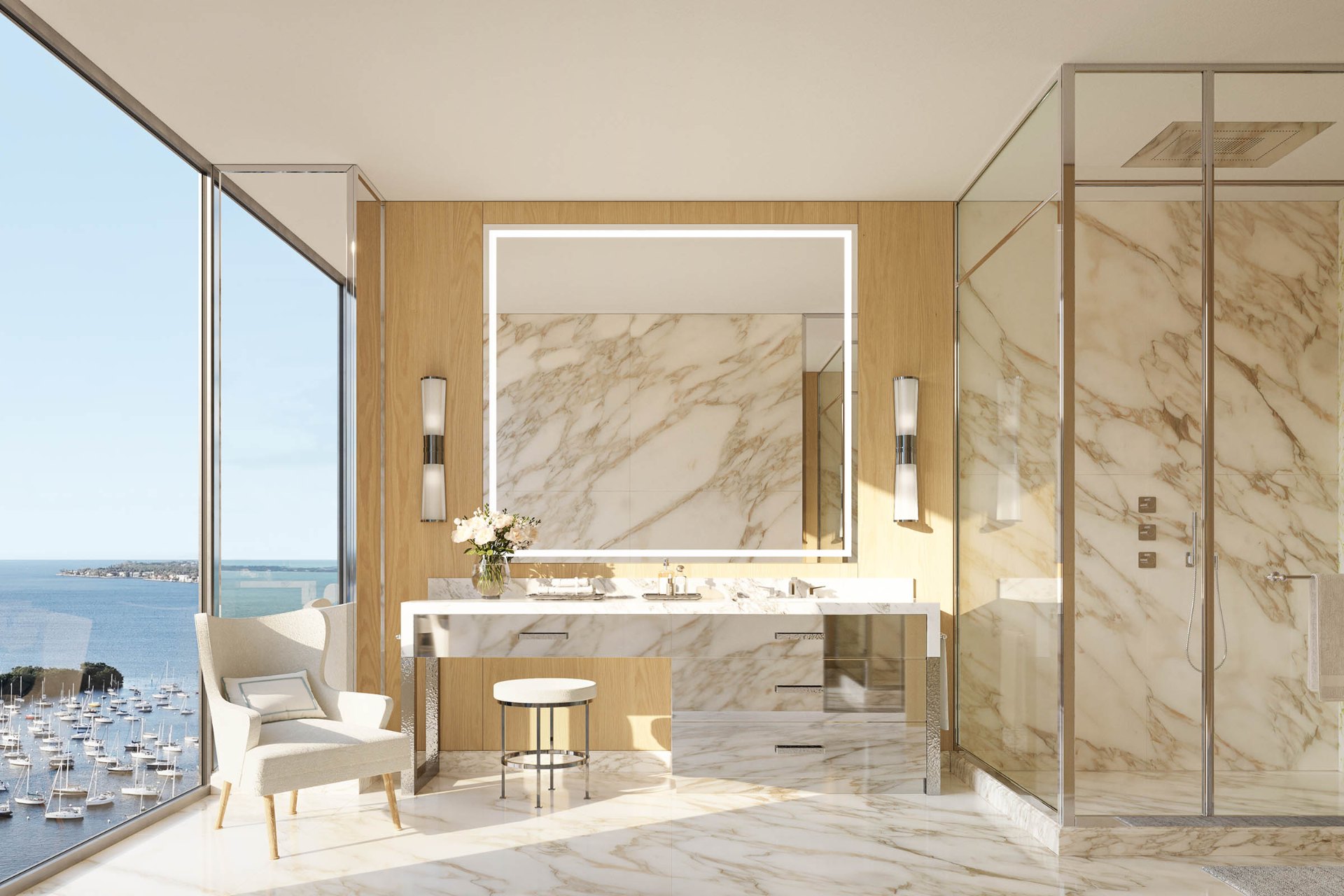
The design language here is warmth without heaviness. Stone in muted earth tones. Wide-format tiles with minimal grout lines that let the surface breathe. Vanities with the clean proportions of fine furniture rather than conventional cabinetry. Everything is slightly oversized — mirrors, ledges, shower enclosures — in the way that genuine luxury tends to be: not because it needs to be larger, but because there was no reason to make it smaller.
Four Seasons’ residential standard is calibrated against decades of hospitality at the highest level. The hardware comes from the same European manufacturers that supply the brand’s most celebrated properties. Soaking tubs are designed to be used, not displayed. The plumbing performs with the quiet confidence of something built to last.
And then there is the light. South-facing residences receive a quality of afternoon sun filtered through the bay’s surface — a luminosity that makes warm stone glow in a way that no specification sheet can capture. In a spa-inspired bathroom in a Miami condo, that kind of light does not complement the design. It completes it.
The St. Regis Residences, Miami
Detail as Discipline
The St. Regis is not a brand that makes compromises visible. Its legacy of Butler Service is built on the understanding that true luxury is the absence of friction — that the finest experiences are the ones where every decision has already been made correctly, invisibly, in advance.
The primary bathrooms at The St. Regis Residences, Miami embody that philosophy with precision.
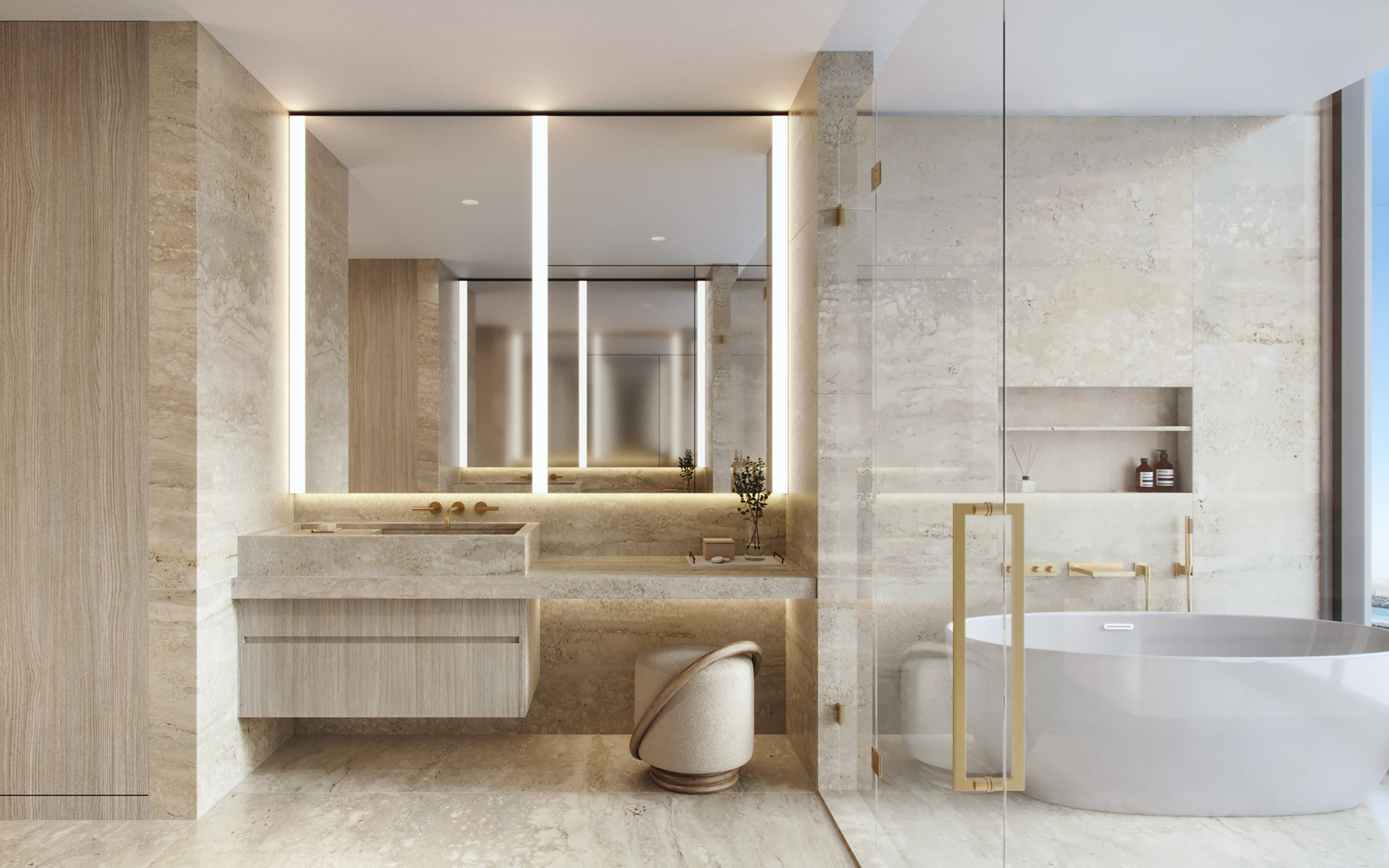
Stone slabs are chosen and book-matched with the care of a couture atelier — veining continuous across surfaces, installation tolerances that eliminate every unnecessary line. Fixtures are monolithic: substantial pieces with the visual gravity of objects that were made to stay. Shower enclosures are frameless, floor-to-ceiling, finished to the point where the glass seems to disappear.
Dual vanity zones are genuinely dual — not two sinks sharing a counter, but two distinct territories with independent mirrors, independent storage, and independent lighting. The heated floors, the recessed niches, the towel systems: these are not amenities. They are the accumulated intelligence of a century of hospitality, applied to a private home.
For buyers who notice the difference between a bathroom that looks right and one that feels right, the St. Regis is the answer.
Rosewood Residences Hillsboro Beach
The View Does the Work
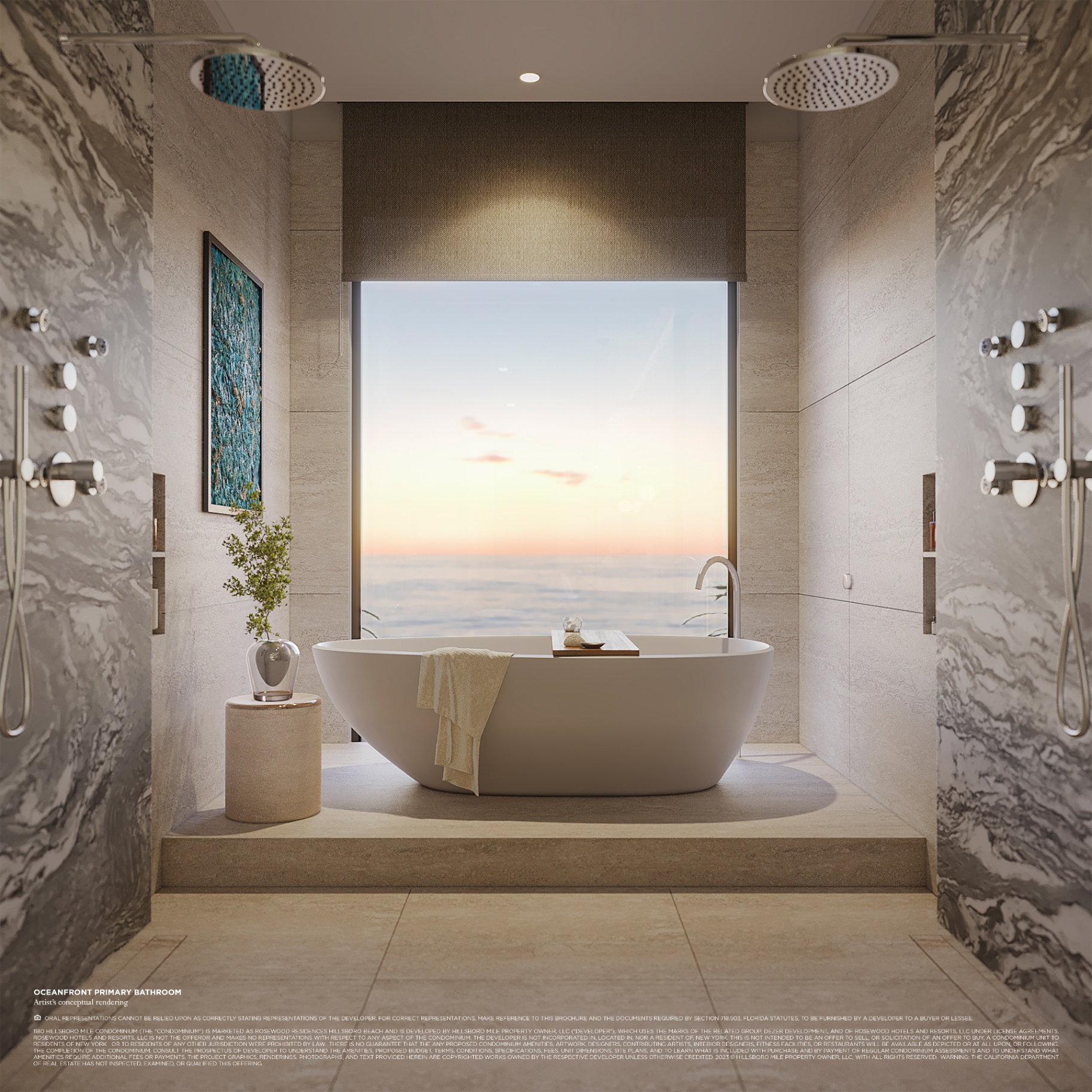
There is a category of design decision that no interior specification can manufacture: the decision to put the right window in the right place.
Rosewood Residences Hillsboro Beach made that decision — and in select residences, it means a freestanding soaking tub positioned against an open Atlantic view. Not a courtyard. Not a city skyline. The ocean itself, from the most private room in the home.
Rosewood’s philosophy — “A Sense of Place,” the belief that every property should feel irreplaceable and specific to its location — shapes the material choices directly. Stone tones that reference the palette of the coastline. Fixtures with the organic warmth of driftwood and water-worn rock. Hardware with patina rather than polish. Nothing that could be transplanted to another project and feel at home.
The broader spa-inspired bathroom tradition in branded residences is well-represented here: steam showers, deep soaking tubs, layered lighting. But the differentiator at Rosewood Hillsboro Beach is the restraint to let the Atlantic carry the room. That kind of confidence — in the view, in the location, in the sufficiency of what is already there — is rarer than any specification.
The Ritz-Carlton Residences, Palm Beach Gardens
Space as Luxury
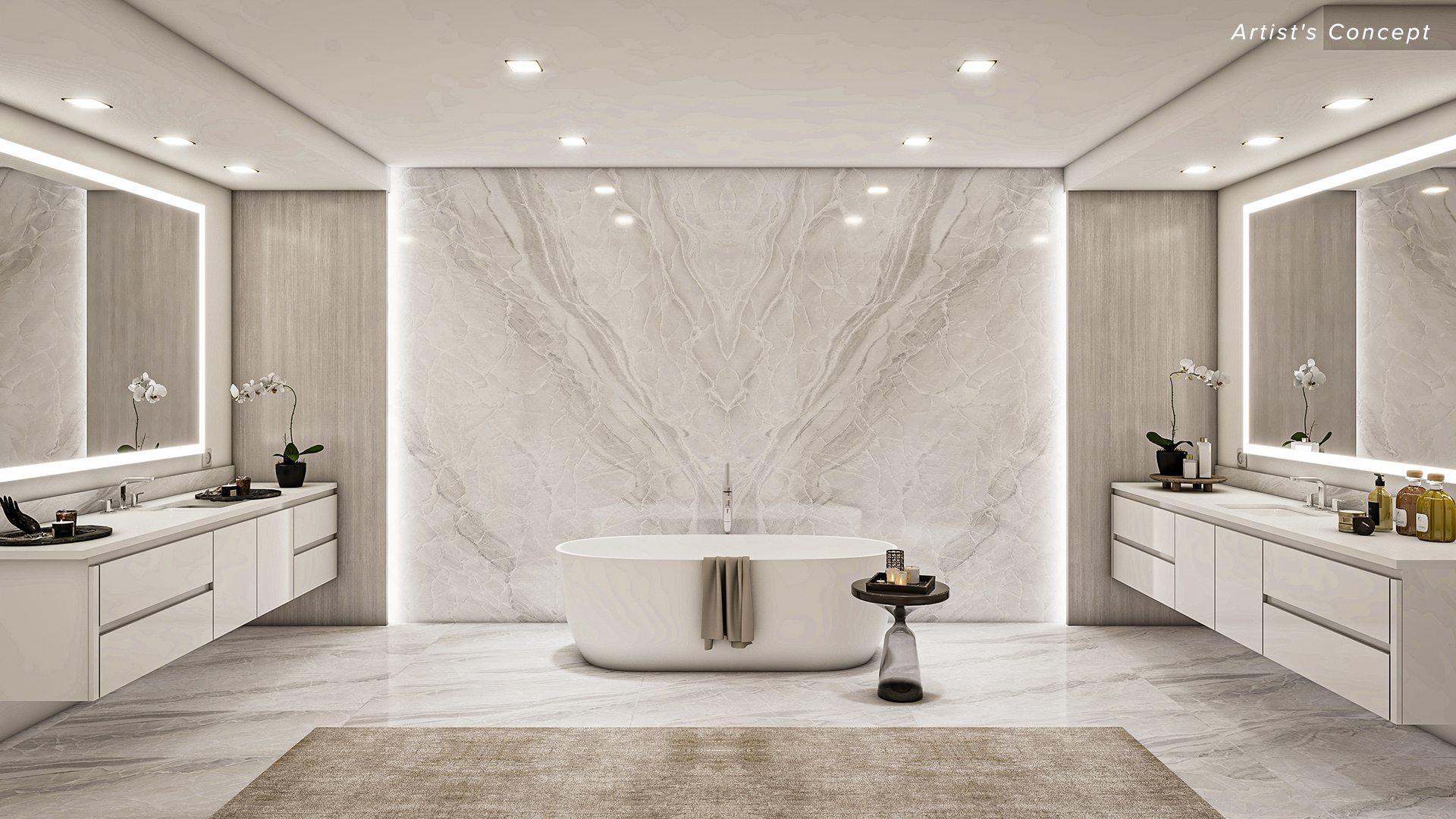
Palm Beach Gardens offers something genuinely scarce in South Florida luxury real estate: room.
The Ritz-Carlton Residences, Palm Beach Gardens draw on that character to deliver primary bathrooms defined not by drama but by scale and calm. Generous footprints. Oversized showers with multiple body sprays, rainfall heads, a bench, and enough square footage to register as a room. Soaking tubs positioned to capture garden or water views through large-format windows. The proportions of a resort spa, in a private residence.
The Ritz-Carlton’s execution standard — developed across more than a century of hospitality at the highest level — brings a consistency that is difficult to replicate. Tilework is immaculate. Stone installation is precise. The lighting design moves through warm, independent circuits: functional brightness for a morning routine, soft ambient warmth for an evening wind-down.
For buyers looking at South Florida luxury new developments beyond Miami, the Ritz-Carlton Palm Beach Gardens makes a quiet but persuasive argument. The finest primary bathroom does not require a city view or a famous address. It requires space, light, and the confidence of a brand that has been doing this — correctly — for a very long time.
What to Look for in a Luxury Primary Bathroom
For buyers comparing projects, the primary bathroom deserves the same scrutiny as the kitchen. A few details that distinguish the exceptional from the merely beautiful:
Stone selection. The quality of stone is not about the name of the material — it is about the slab, the book-matching, and the precision of the installation. Continuous veining across surfaces is a sign of care. Mismatched slabs are a sign of cost-cutting.
Natural light. The finest bathrooms have a relationship with daylight. Look for window placement that brings light into the shower and tub zones, not just the vanity.
Fixture provenance. European manufacturers — Gessi, Dornbracht, Fantini, Waterworks — produce hardware that is meaningfully better than mass-market alternatives. The difference is tactile before it is visual.
Lighting circuits. Independent control of task, ambient, and accent lighting is the detail that transforms a bathroom from a functional room into an experiential one. Easy to overlook in a sales presentation. Impossible to add after.
Shower specification. Rainfall heads are standard. Steam function, body sprays, a bench, and genuine square footage are what separate a shower from an enclosure.
Tub geometry. Freestanding tubs vary enormously in whether they function as objects or as baths. Flat-bottomed interiors with real depth are rarer than they appear in renderings.
Need details on these residences?
Our advisory team can share current information on the projects referenced in this guide.
Speak With an Advisor →