The Family Office Buyer: How South Florida’s Ultra-HNW Market Has Organized Around Institutional Buyers
The family office buyer represents the most financially sophisticated segment of South Florida’s luxury new development market — and the segment that has grown most rapidly since the Wall Street South migration that began in 2020. In 2025, South Florida recorded 361 sales above $10M — the second-highest annual total on record — and a significant proportion of these transactions were executed by or on behalf of family offices and ultra-high-net-worth institutional buyers.
Understanding how these buyers evaluate, structure, and close on South Florida luxury real estate is useful both for buyers in this category and for sellers, developers, and brokers who serve them.
What a family office is
A family office is a private organization that manages the investments, tax planning, estate planning, and lifestyle services for one family (single-family office) or multiple families (multi-family office). The threshold for a single-family office typically begins at $100M–$200M+ in investable assets; below this level, the cost of maintaining a full family office team exceeds the management fee savings relative to institutional alternatives.
The family office’s investment mandate typically includes liquid investment management (public equities, fixed income, hedge funds, private equity), direct investments (operating businesses, venture capital, real estate), tax and estate planning, generational wealth transfer, and lifestyle and concierge services for the family’s daily operational needs. Real estate is typically a component of the direct investment allocation — treated as a store of value, an inflation hedge, and a portfolio diversification tool rather than primarily as a lifestyle purchase.
How family office buyers evaluate South Florida real estate
As an asset class. Family offices treat luxury real estate as an asset within a portfolio context. They evaluate liquidity (how quickly the asset can be sold at close to market value, which favors branded residences in liquid markets over boutique one-of-a-kind properties), income potential (rental yield if the property is not permanently occupied), appreciation trajectory (documented price trajectory, market dynamics, and the specific drivers that suggest continued appreciation), and correlation (real estate’s low correlation to public equity markets is a portfolio diversification benefit).
As a provenance asset. Ultra-HNW buyers and family offices specifically prefer buildings with verifiable architectural and brand provenance — Pritzker Prize architects, globally recognized hospitality brands, documented resale performance in comparable buildings. Provenance is the primary defense against depreciation in a market downturn; buildings with extraordinary pedigree maintain value through market cycles better than even very good buildings without distinctive credentials.
As an estate planning vehicle. Family offices frequently purchase South Florida real estate through specific ownership structures — qualified personal residence trusts (QPRTs), LLCs, or irrevocable trusts — that serve specific estate planning purposes. The purchase decision is often made in conjunction with the family’s estate attorney, whose input on ownership structure precedes the purchase and shapes the transaction.
The South Florida buildings that have built family office relationships
Arte Surfside. Arte’s 16 full-floor residences have attracted a disproportionate number of family office and ultra-HNW buyers. The combination of full-floor privacy, Antonio Citterio architectural authorship, Surfside’s quiet character, and the building’s documented resale premium ($5,000+ PSF) makes it the closest thing to an institutional-quality residential trophy asset available in South Florida.
Aman Residences Miami Beach. The Aman brand’s scarcity (roughly 35 residences globally at any given time; Miami Beach has approximately 35–50 units) and its documented price premium in resale markets — Aman properties in comparable locations consistently command 20–40% premiums over non-branded equivalents — make it a portfolio-quality asset as well as a lifestyle purchase. Family offices that own Aman residences in Turks and Caicos or Bali often complete the US component with Aman Miami Beach.
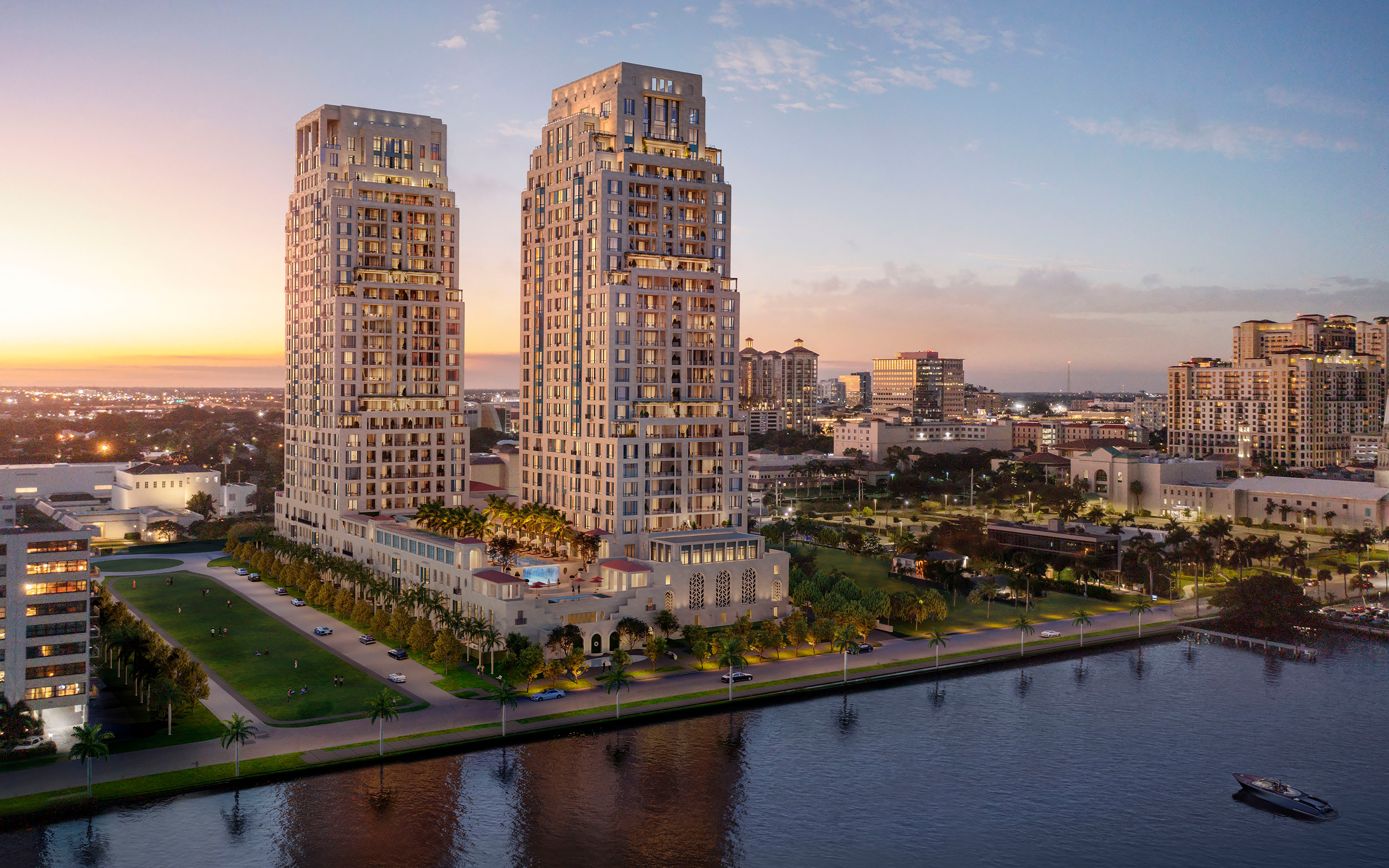
South Flagler House, West Palm Beach. RAMSA’s prewar architectural DNA, the WPB Intracoastal site’s documented 187% decade appreciation, and the Citadel/Wall Street South demographic context create a combination that family offices’ real estate analysts recognize as having genuine long-term investment merit beyond the lifestyle proposition.

Waldorf Astoria Residences Miami. The supertall’s novelty (no equivalent exists in Florida; the product is genuinely unique) appeals to the family office buyer who specifically values scarcity. The full-floor penthouse at 1,000 feet of elevation is the kind of unrepeatable trophy asset that family offices acquire as generation-defining investments — the property that defines a family’s South Florida positioning.
The Citadel effect and its broader implications
Ken Griffin’s relocation of Citadel from Chicago to Miami in 2022 — accompanied by approximately $1B in South Florida real estate purchases across Palm Beach Island and Miami — was not merely a personal real estate transaction. It was a signal to the institutional capital community that South Florida had reached the quality threshold that ultra-HNW buyers and family offices require for primary residence consideration.
Since Griffin’s relocation, the Wall Street South migration has continued: Goldman Sachs’ WPB office, the broader hedge fund and family office migration to Palm Beach County, and the institutional validation effect that follows when a buyer of Griffin’s profile and financial sophistication makes a public commitment to a market. The result is a self-reinforcing dynamic: each major institutional buyer’s arrival makes the market more attractive to the next, building the community density that makes long-term primary residence genuinely viable.

Educational only; not financial, legal, or tax advice. Ownership structures, estate planning, and cross-border considerations require qualified counsel. HL Real Estate Group: realestate@hauteleaders.com.
Need details on these residences?
Our advisory team can share current information on the projects referenced in this guide.
Speak With an Advisor →