The 5 Most Extraordinary Kitchens in South Florida New Developments
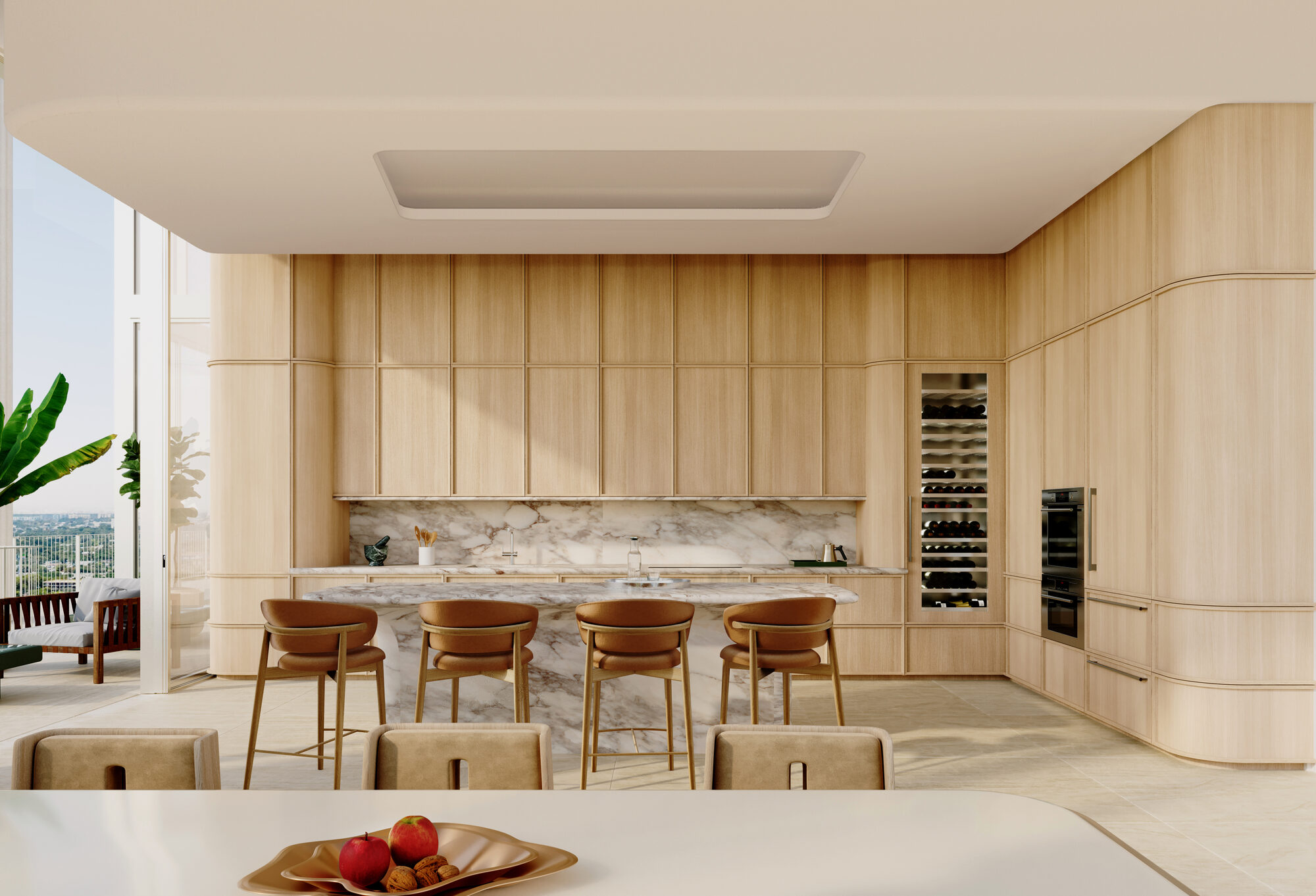
In South Florida’s new development market, the kitchen is the most revealing room in the building. Developers who are genuinely committed to quality spend on the kitchen — on cabinetry makers with 70-year histories, on appliance suites that exceed what most restaurants can afford, on countertop materials quarried from specific Italian provinces for specific aesthetic reasons. Developers who are performing luxury spend on the lobby and the renders, then value-engineer the kitchen when no one is looking.
The five kitchens below are the ones where the full commitment is visible — where the design logic, the material selection, and the appliance specification are coherent from first principle rather than assembled from a developer’s preferred vendor list.
1. Fouquet’s Hotel & Residences Miami Design District — RDAI Kitchen Design
RDAI — the Paris-based interior design studio responsible for every Hermès retail environment worldwide — is designing the kitchens at Fouquet’s Hotel & Residences Miami Design District. This is not a detail. RDAI’s work for Hermès is considered among the most rigorous material environments produced by any design practice in the world; their involvement with Fouquet’s brings that same philosophy to a residential kitchen context.
The RDAI kitchen design at Fouquet’s centers on custom oak and wood-lacquered cabinetry — a warm, material-rich palette that reflects the French residential interior tradition rather than the cold-white minimalism that has dominated Miami luxury kitchens for the past decade. Countertops are quartz throughout standard residences, with stone countertops and backsplash reserved for penthouse configurations. The appliance suite is the Sub-Zero/Wolf combination — refrigerator and freezer as separate units (Sub-Zero), wine refrigerator (Sub-Zero), cooktop (Wolf), wall oven (Wolf), hood (Wolf), dishwasher (Sub-Zero). The microwave/speed oven adds a functional tier above standard luxury specifications.
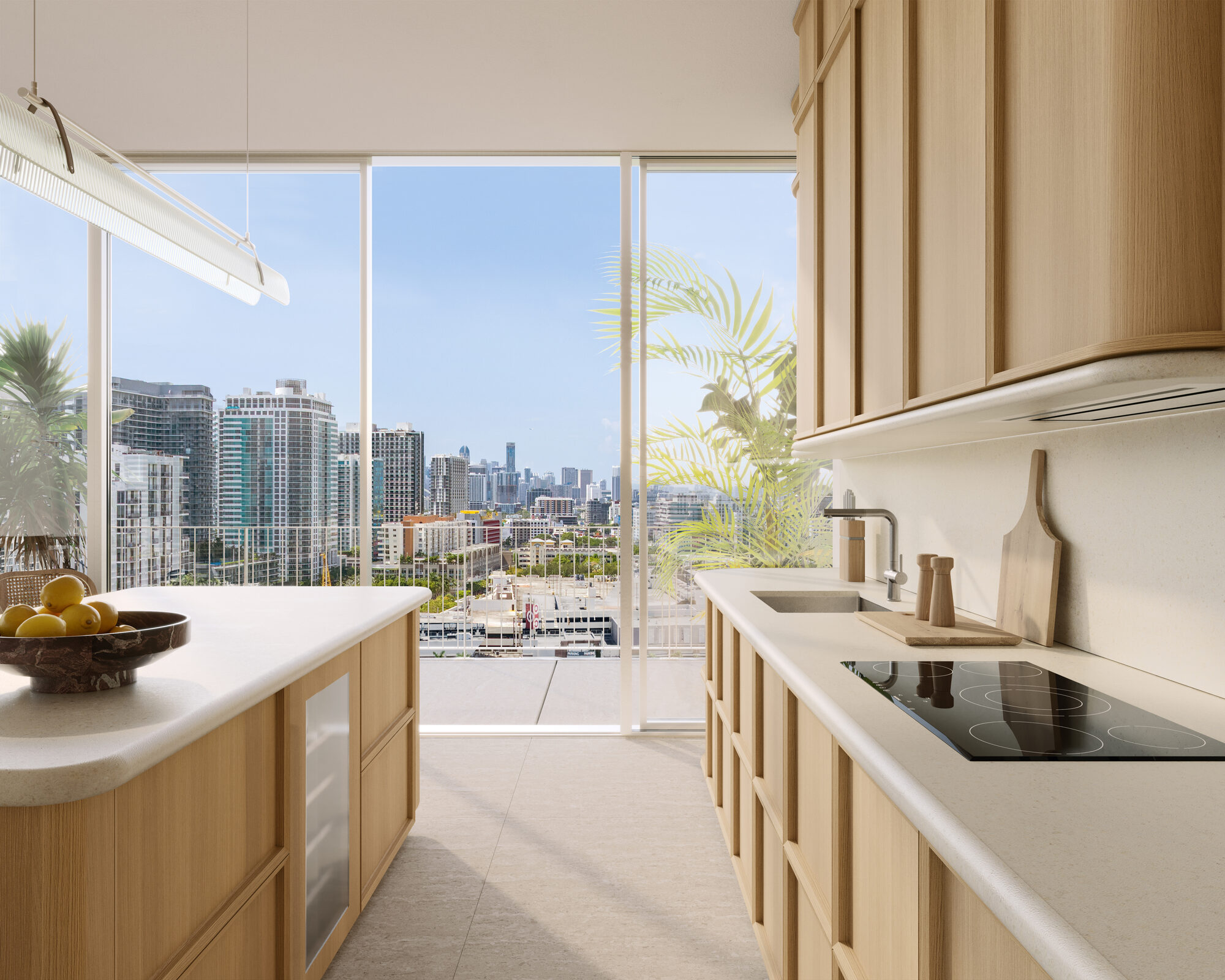
What distinguishes the RDAI kitchen at Fouquet’s from comparable Miami luxury kitchens is not the appliance list — it is the design coherence. RDAI does not design components; they design environments. The relationship between the cabinet door profile, the hardware finish (specialty satin stainless steel), the countertop edge detail, and the backsplash material is considered as a unified composition rather than a series of independent selections. This is the kitchen as a room that has been thought about, not assembled.
The Fouquet’s kitchen also benefits from the building’s overall hospitality identity: residents have access to Fouquet’s full food and beverage programming — two restaurants, a bar, a patisserie — which means the kitchen’s function within the residence is genuinely complemented by the building’s culinary infrastructure rather than being the only option.
2. Eighty Seven Park Miami Beach — Renzo Piano Building Workshop Philosophy
The kitchen at Eighty Seven Park does not announce itself. This is the point. Renzo Piano’s architectural philosophy — which earned him the Pritzker Prize in 1998 and produced the Pompidou Centre, the Getty Center, and the Whitney Museum of American Art — is fundamentally about how light moves through space and how materials age into their environment. The RPBW-informed kitchen at Eighty Seven Park reflects this discipline: it is the kitchen that disappears into the architecture rather than competing with it for attention.
The specific kitchen specification at Eighty Seven Park features Italian cabinetry with a matte lacquered finish in warm neutral tones that read as part of the wall rather than furniture imposed on it. The countertops are natural stone — selected for their specific variation and warmth — and the backsplash maintains the same material continuity rather than introducing a contrasting element. Gaggenau appliances complete the suite: the German brand whose reputation in the ultra-luxury kitchen market rests on its induction cooking technology, its column refrigeration system, and its under-counter wine conditioning units.
The Eighty Seven Park kitchen is the kitchen for the buyer who understands that restraint is a form of sophistication — that the most intelligent design choices are often the ones that don’t demand to be noticed.
3. The Perigon Miami Beach — OMA’s Kitchen as Architectural Component
OMA — the Rotterdam-based firm founded by Rem Koolhaas, whose office designed the CCTV Building in Beijing, the Fondazione Prada in Milan, and Milstein Hall at Cornell — designed The Perigon’s interiors with the same intellectual rigor that characterizes the firm’s architectural work. The kitchen at The Perigon is treated as an architectural component of the floor plan rather than a room inserted into it — a spatial position that reflects OMA’s analytical approach to how people actually inhabit domestic space.
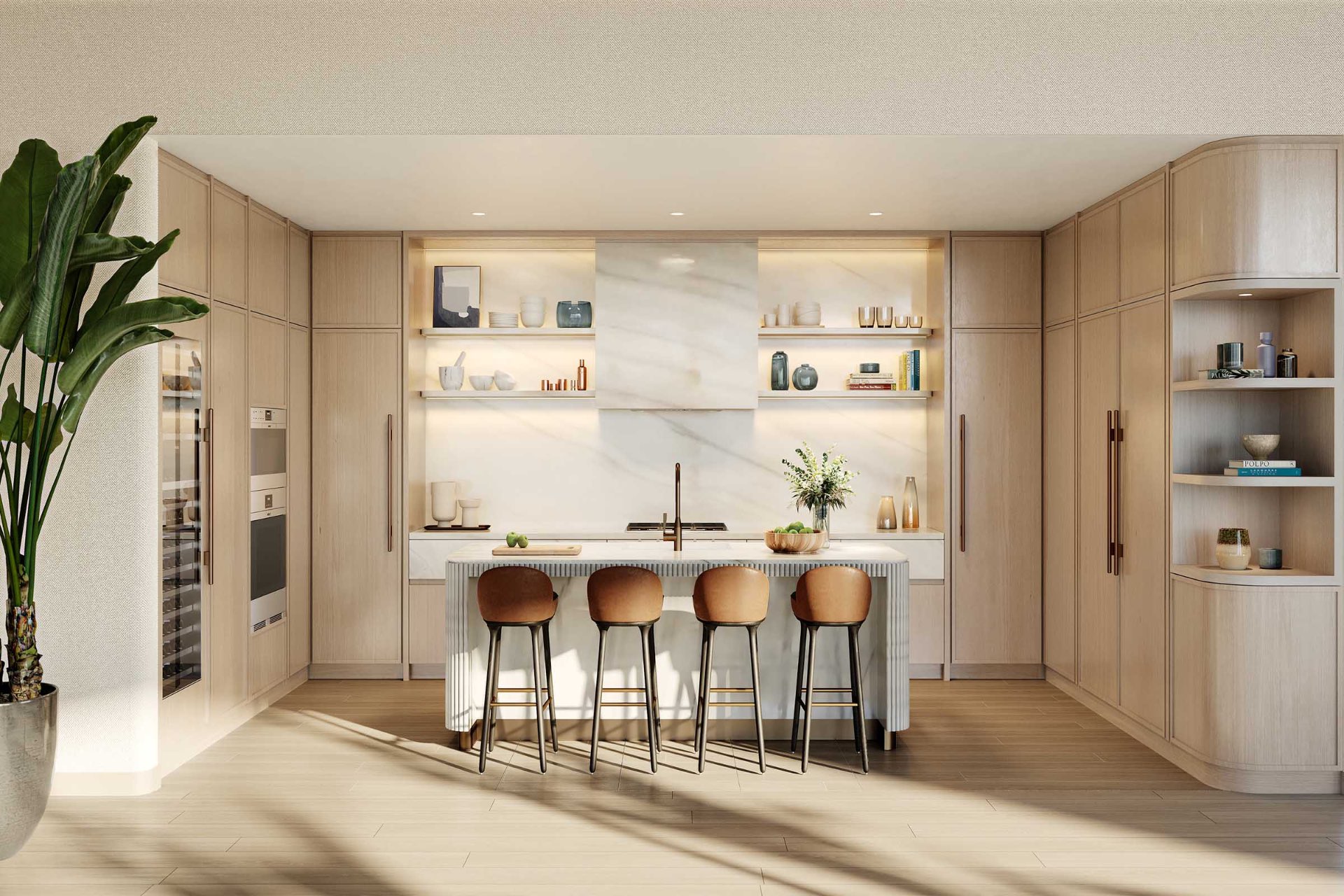
The Poliform kitchen system at The Perigon is specified to the Italian manufacturer’s highest residential tier — integrated handle-free cabinet doors in a palette that responds to the building’s material language, Miele appliances throughout (the German brand that consistently tops professional kitchen rankings for reliability and performance), and a countertop specification that continues the floor material into the kitchen surface in a way that eliminates the visual boundary between cooking and living zones.
The kitchen’s positioning within The Perigon’s open floor plan is itself an OMA design decision: it faces the Atlantic Ocean view rather than backing against it, which means cooking in this kitchen is always an activity performed in relationship to the horizon — a spatial arrangement that is unusual in luxury residential kitchens and that makes the daily experience of using the kitchen feel architecturally considered rather than functionally incidental.
4. Five Park South Beach — Gabellini Sheppard’s Custom Italian Kitchen
Five Park South Beach — developed by iStar and designed by Arquitectonica with interiors by Gabellini Sheppard, the New York firm best known for the Jil Sander flagship stores and the Hotel Puerta América — is the most recently delivered building on this list (completed 2025) and arguably the most immediately beautiful kitchen to stand in.
Gabellini Sheppard’s specification at Five Park centers on Italian-made kitchen cabinets custom-designed for the building — not a catalog system adapted for the project, but cabinetry designed from scratch for Five Park’s specific spatial proportions, material palette, and lifestyle brief. The integrated wood-top dining tables that extend from the kitchen island in select configurations are a Gabellini Sheppard design detail that has appeared in multiple architecture publications: the kitchen’s relationship to the dining zone is resolved through a single continuous material element rather than requiring a separate piece of dining furniture.
The Gaggenau appliance suite at Five Park — consistent with the building’s architectural positioning at the top of South Beach’s new residential market — includes the brand’s induction cooktop, column refrigeration, wall ovens, and wine conditioning units. The Hansgrohe fixtures in kitchens and bathrooms are specified at the brand’s Axor tier — the architectural line developed in collaboration with Philippe Starck, Antonio Citterio, and Jean-Marie Massaud — which sits above the standard Hansgrohe residential offering.
Five Park’s 98 residences across 48 stories means each kitchen is in a building where the ratio of quality investment to number of units is significantly more favorable than in 300-400 unit developments. The per-unit development budget that goes into the kitchen at Five Park is structurally higher than what is possible in a larger building at the same overall project price point.
5. Four Seasons Private Residences Coconut Grove — Michele Bönan’s Italian Warmth
Michele Bönan — the Florentine interior designer responsible for the Lungarno Collection hotels (including the Hotel Lungarno and the Portrait Roma) and widely considered one of Europe’s most accomplished hospitality interior designers — is designing the interiors at Four Seasons Private Residences Coconut Grove. His kitchen design for the building reflects his specific aesthetic position: a deeply Italian sense of warmth and material quality, filtered through decades of hospitality design that has taught him exactly how spaces feel to live in rather than merely look at.
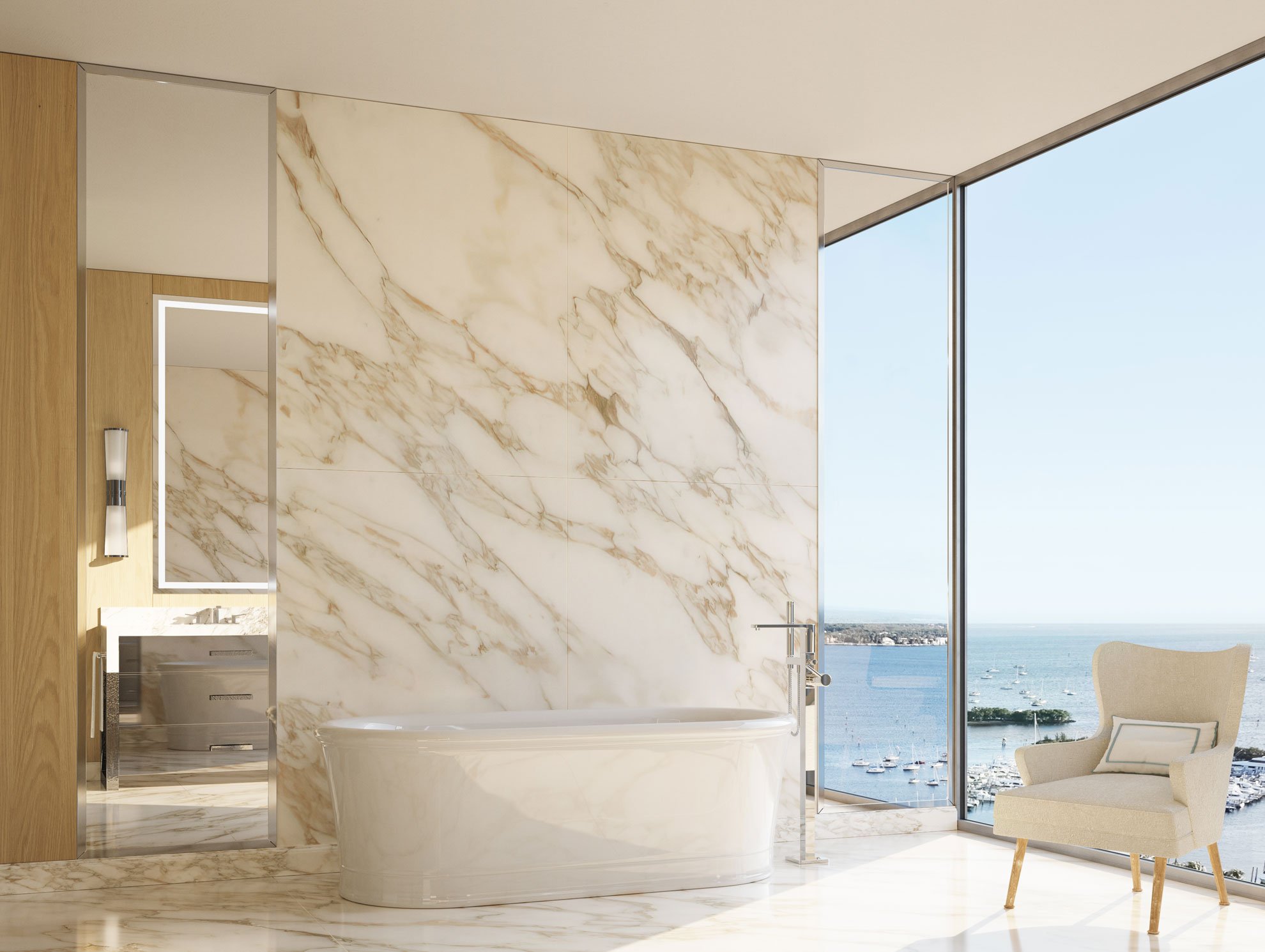
The Bönan kitchen at Four Seasons Coconut Grove works in warm tones — natural oak cabinetry with a depth of grain that reads differently at different times of day, stone countertops with a specific tactile quality, and fixtures in finishes that age gracefully rather than requiring the constant maintenance that polished chrome demands. The appliance suite is specified to Four Seasons’ residential standards — a brand requirement that ensures the kitchen performs at a level consistent with the Four Seasons service philosophy applied to the cooking environment.
What makes the Bönan kitchen specifically appropriate for Coconut Grove is its relationship to the neighborhood’s character. Coconut Grove is South Florida’s most architecturally mature neighborhood — the one with the oldest trees, the most established sense of place, the most layered community identity. Bönan’s Italian warm-materials approach belongs in this context in a way that a cold-chrome minimalist kitchen would not. The kitchen feels like it has always been there, which is the highest compliment you can pay to a kitchen that was designed last year.
Why Kitchen Quality Matters Beyond the Kitchen
The kitchen is the most useful proxy for overall build quality in a luxury new development because it is the hardest room for a developer to fake. An impressive lobby can be achieved with relatively focused investment on a few visible elements — a dramatic ceiling height, quality stone on the feature wall, good lighting. An impressive kitchen requires sustained commitment across every component: cabinetry maker, appliance specification, countertop material, hardware selection, installation quality, and the design coherence that holds all of it together.
A developer who has genuinely invested in the kitchen has genuinely invested in the building. A developer whose kitchen appliances are from the second tier of a luxury brand’s lineup — or whose cabinetry is from a volume manufacturer — is telling you something about where the investment stopped. Read the kitchen spec sheet as carefully as you read the amenity brochure.
Need details on these residences?
Our advisory team can share current information on the projects referenced in this guide.
Speak With an Advisor →