Art Collectors and South Florida New Developments: The Buildings That Actually Work for Serious Collections
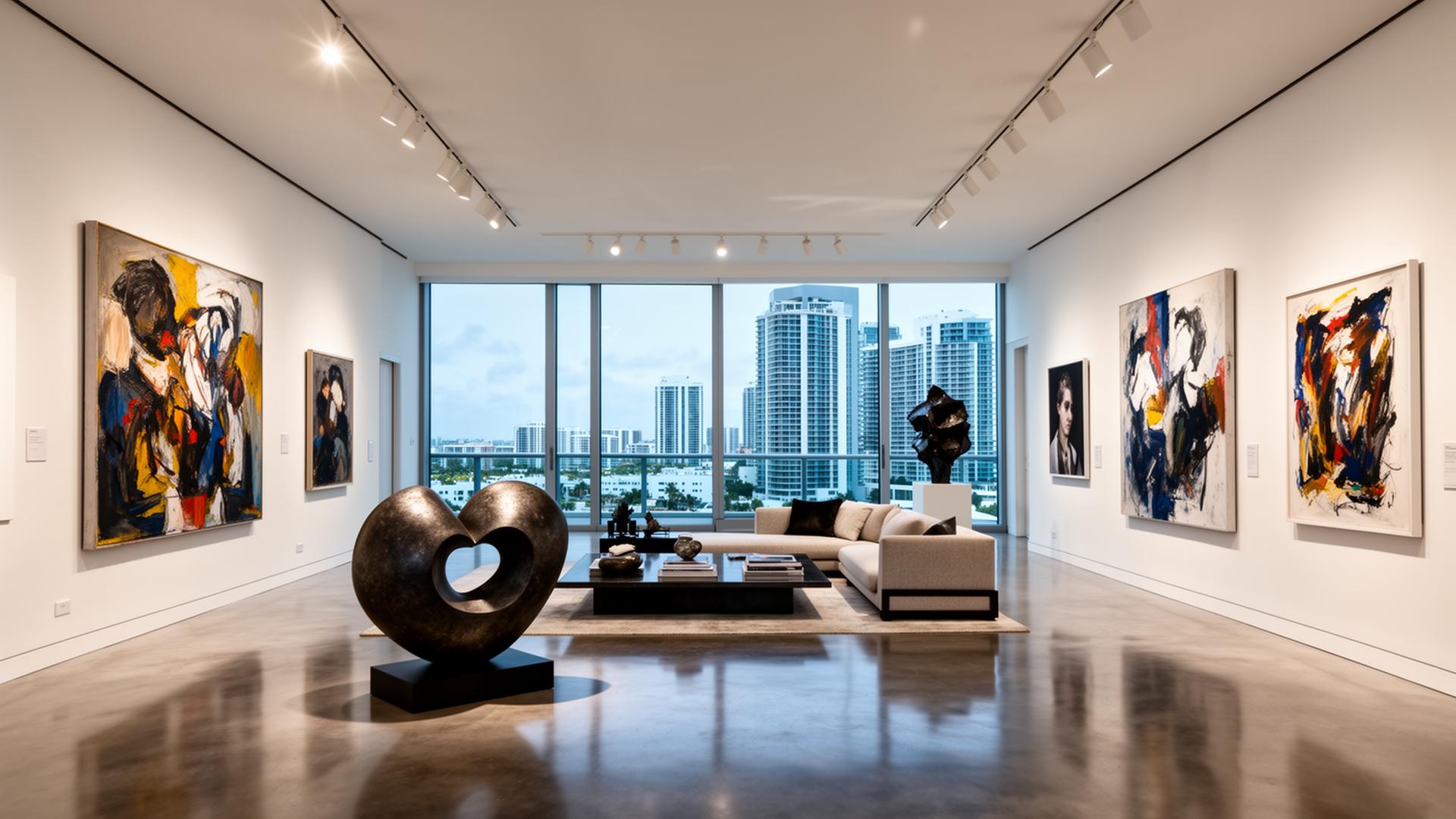
South Florida has become one of the world’s most significant art markets — Art Basel Miami Beach is the hemisphere’s most important art fair, the Design District’s gallery programming is among the densest in the United States, and the collector demographic that occupies the luxury residential buildings this guide covers is, at the highest tier, genuinely serious about art. Some of these buyers have collections valued at $5M–$50M. Their residence is not merely a home; it is an exhibition environment.
The problem is that most luxury condos — even expensive ones, even branded ones, even ones with famous architects — are not designed with art display as a primary consideration. They are designed for photography, for lifestyle aspirations, and for market positioning. The things that make a residence genuinely usable for a serious art collection — ceiling heights that accommodate large works, walls that are not interrupted by structural columns or mechanical equipment, UV-protected glazing, HVAC precision, and the security protocols that insurers require — require specific design decisions that are not the automatic consequence of spending a lot on the building.
The Four Non-Negotiables for Serious Art Collectors
1. Ceiling Height: The First Filter
Serious art collecting increasingly involves large-format works — canvases above 8 feet tall, sculptures above 6 feet, diptychs and triptychs that require 20+ linear feet of continuous wall to display as a unit. These works exist in significant private collections; they are acquired at Art Basel, at Christie’s and Sotheby’s New York and London, and through the gallery programs of artists who work at scale.
A 9-foot ceiling can display works up to approximately 72 inches (6 feet) tall with appropriate negative space above. A 12-foot ceiling extends this to approximately 84 inches (7 feet). A 14-foot ceiling to approximately 108 inches (9 feet). A 22-foot ceiling — THE WELL Coconut Grove’s loft configurations — to works approaching 15 feet.
The applicable standard: Collectors who own or plan to acquire works by Rashid Johnson, Mark Bradford, Cecily Brown, Julie Mehretu, and comparable painters working at scale require 12-foot minimum ceilings for comfortable display, 14-foot ceilings for works to 9 feet, and 22-foot ceilings for the largest contemporary works that appear at auction.
2. Continuous Wall Space: The Configuration Problem
The standard luxury high-rise floor plan creates multiple display problems for serious collectors: floor-to-ceiling glazing (beautiful for views, useless for wall-hung art); structural columns that interrupt walls in the middle of potential display spaces; mechanical equipment (HVAC registers, sprinkler heads, building systems) distributed across walls and ceilings in positions that complicate installation; and residential architecture that prioritizes the view over every other spatial consideration.
The best art-collection residences in South Florida’s new development pipeline provide:
- A minimum of 20 continuous uninterrupted linear feet of wall at display height (8 feet minimum clear wall from floor to ceiling) in at least one primary room
- A gallery sequence (entry gallery or connecting hallway) with sufficient length and blank wall space to create a linear display
- Primary rooms where at least one full wall is not glazed to the ceiling
Buildings that provide this most consistently: South Flagler House (RAMSA’s classical floor plan includes significant blank wall areas in living rooms with non-glazed interior walls), Arte Surfside (full-floor configuration provides maximum flexibility in wall placement), and Eighty Seven Park (Piano’s restrained glazing allows more solid wall area than comparable oceanfront towers).
3. UV-Protected Glazing: The Conservation Requirement
UV radiation from South Florida’s intense subtropical sunlight is among the most significant risks to paper, canvas, and photographic materials. Unprotected glass transmits approximately 75% of UV radiation; unprotected acrylic glazing transmits somewhat less but remains significant.
Conservation-quality UV protection requires glazing with UV transmission below 1% — typically achieved through laminated glass with UV-blocking interlayers, or through window film applied to existing glazing. The distinction matters significantly for collectors with significant paper-based works (watercolors, drawings, prints) and photographic works, which are the most UV-sensitive media.
What to ask: Request the specific solar control glazing specification — solar heat gain coefficient (SHGC), visible light transmittance (VLT), and UV transmission percentage. Buildings that specify Viracon, Guardian SunGuard, or equivalent high-performance glazing packages will have UV transmission well below 1% as a standard feature. Buildings that specify standard double-pane insulated glass may transmit 30–60% of UV radiation.
The practical implication: Works on paper (drawings, prints, photographs), textile-based works, and photographic prints — which constitute a significant portion of most serious collections — will fade measurably within 3–5 years of regular exposure to South Florida’s direct sunlight through standard glazing. The collector who purchases a $200,000 Richard Serra aquatint and displays it in a room with standard glazing is watching a significant investment degrade in real time.
4. HVAC Precision: The Climate Control Requirement
Museum standard climate control for art storage and display: 65–70°F consistent temperature (fluctuation of more than 5°F in 24 hours is considered damaging to most media), 45–55% relative humidity (fluctuation below 40% causes cracking in paint layers and wood supports; above 60% promotes mold growth on paper and canvas).
South Florida’s climate — 90°F+ summer temperatures and 70–80% outdoor humidity in the summer months — means that the building’s mechanical systems are working against a very large differential between interior target conditions and exterior conditions. Buildings whose HVAC is sized and controlled for conventional comfort (a temperature band of 68–76°F without active humidity control) may allow interior humidity to fluctuate significantly during power interruptions, when the building’s mechanical systems are in scheduled maintenance, or during periods of extreme outdoor humidity.
What to ask: What is the building’s HVAC system design redundancy for humidity control? Does the individual unit’s mechanical system maintain independent humidity control, or is humidity control centralized at the building level? What are the documented performance standards for temperature stability over 24-hour periods?
Buildings with the most sophisticated environmental systems: Aman Residences Miami Beach (the brand’s global standard for material preservation applies to the residential environment), THE WELL Coconut Grove (green building certification requires documented HVAC performance standards).
The Miami Design District Advantage: Gallery Infrastructure as a Neighborhood
For the collector who understands that their residence is part of a broader collection ecology — that the gallery they buy from, the conservation specialist they retain, and the art storage facility they use are all part of the collection’s management infrastructure — the Miami Design District offers a neighborhood advantage that no other South Florida location matches.
The Design District’s gallery ecosystem — including Perrotin, Gagosian, Pace, and dozens of secondary galleries — operates within walking distance of Fouquet’s Hotel & Residences. Collector buyers at Fouquet’s can have a direct working relationship with multiple major galleries without requiring car travel; openings, studio visits with artists showing in the district, and the informal conversations that constitute serious collecting are all accessible on foot.
The adjacency to Art Basel Miami Beach’s primary audience — the Design District is the neighborhood where Art Basel buyers and dealers concentrate their social activities during fair week — means that Fouquet’s residents have a social relationship with the collecting community that residents in Brickell, Sunny Isles, or Palm Beach do not.
Coconut Grove: The Alternative Collector’s Neighborhood
Coconut Grove’s specific appeal for collectors is its proximity to the South Florida art establishment as a social community — the collectors, curators, and museum professionals who have lived in the Grove for decades, who organize the Coconut Grove Arts Festival, and who have built the neighborhood’s identity around cultural depth rather than luxury consumption.
For collectors who value the engaged collector community over gallery adjacency — who buy primarily at Art Basel and in New York but want a neighborhood with cultural identity rather than cultural tourism — Coconut Grove’s established collecting community makes THE WELL and Four Seasons Private Residences Coconut Grove appealing collection environments.