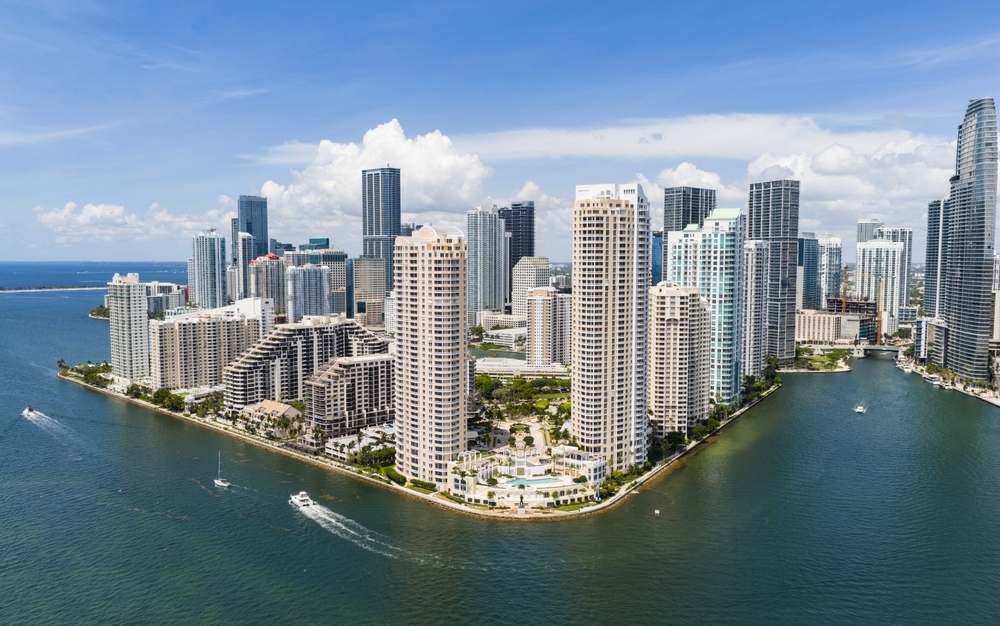
A master-planned, controlled-access 44-acre island in Biscayne Bay, reached by a single bridge from mainland Brickell — Miami's most deliberate exercise in engineered scarcity.
In the 1980s, Swire Properties built an island. Brickell Key was master-planned from the ground up as a self-contained residential enclave in the shadow of Miami's financial district skyline — its own internal streets, its own 1.5-mile Bay Walk, and exactly one road in and out. Nearly four decades later, that single bridge is still the defining fact of daily life here: it is what makes the island feel, as its newest development's own marketing puts it, like "an island on an island." There is no more land to add and no second bridge to build — the scarcity is structural, not manufactured.
Brickell Key has 11 buildings currently tracked in the Haute Building Index™, forming one of Miami's most established island condo ecosystems — Brickell Key One (1982) and Brickell Key Two (1991) anchor the island's early era; Courvoisier Courts (1997), One Tequesta Point (1995), Two Tequesta Point (1999) and Three Tequesta Point (2001) built out its mid-period; and Courts Brickell Key (2002), Carbonell (2005), Asia (2008), Isola and St. Louis round out a roster spanning roughly 2,900 existing residences before a single unit of new construction. Browse the full Building Index™ →
For roughly 25 years, the Mandarin Oriental hotel anchored Brickell Key's southern tip as one of Miami's only true five-star properties. Swire Properties has since cleared that site for its successor: The Residences at Mandarin Oriental, Miami, a KPF-designed residential redevelopment with interiors by Laura Gonzalez and Tristan Auer, priced from approximately $4.3M and targeting 2030 delivery. It is the only active new-development project on the island, and it carries real weight: two $49.9M penthouse transactions — nearly $100M combined — were reported as record-setting condominium sales for mainland Miami, at approximately $6,300 per square foot, ahead of a single tower rising.
Developer Swire Properties, architecture by Kohn Pedersen Fox, interiors by Laura Gonzalez and Tristan Auer. Full pricing, floor plans and delivery detail on the dedicated development page.
North TowerSee the dedicated North Tower profile for residence mix, hotel-collection units and current availability.
South TowerHome to the two reported $49.9M record-setting penthouse sales. See the dedicated South Tower profile for full detail.
Mainland Brickell is Miami's dense, high-rise financial district — walkable to restaurants, retail and a 24-hour street-level energy, with its own deep pipeline of branded towers including The St. Regis Residences Miami, Cipriani Residences Miami and 619 Brickell. Brickell Key trades that density for water on nearly every side: lower-rise outside its signature towers, one road in and out, no through-traffic, and views that face open bay rather than the next building. Neither is objectively better — buyers choosing Brickell prioritize daily walkability and urban access; buyers choosing Brickell Key prioritize privacy, water exposure and a quieter residential rhythm while staying minutes from Brickell's restaurants and offices.
Brickell Key has a limited on-island dining and convenience ecosystem — Brasserie Brickell Key and The Mexican, which opened in April 2026, are current options — rather than the street-level retail density of mainland Brickell. Its defining amenity remains the waterfront environment: a 1.5-mile perimeter Bay Walk open to the public, controlled single-bridge access, and 360-degree water exposure across Biscayne Bay, the mouth of the Miami River and the Brickell Channel. It is a setting built for buyers who want to feel, at the end of the day, that they have left Miami's density behind — not for buyers who want spontaneous neighborhood life. Those buyers, per our own coverage comparing the island to Coconut Grove and Edgewater, tend to eventually question whether an island setting serves them at all.
Swire Properties’ original bet — that a controlled-access island one bridge away from a booming financial district could hold its own value proposition for four decades — has been repeatedly validated, most recently by two reported $49.9M penthouse closings — record-setting for mainland Miami — before a single tower has risen on the old hotel site. The market entity here is larger than any one development: it’s an established 11-building ecosystem with its own resale market, now getting its first genuinely new flagship address in a generation. Buyers should evaluate Brickell Key on the island’s own terms — privacy, water exposure, single-bridge access — not as a Brickell substitute.
Geographically adjacent but functionally distinct. Brickell Key is a master-planned, controlled-access 44-acre island reached by a single bridge from mainland Brickell; standard vehicles pass through a visitor lane, with a resident-only gate for added security. It shares Brickell's Biscayne Bay skyline but operates as a quieter, lower-density, primarily residential community, while mainland Brickell is Miami's dense financial and nightlife district.
The original Mandarin Oriental Miami hotel, which anchored the island's southern tip for roughly 25 years, was demolished by developer Swire Properties to make way for The Residences at Mandarin Oriental, Miami — a two-tower, KPF-designed residential redevelopment with a Mandarin Oriental–branded service model.
The Haute Building Index™ currently tracks 11 established condominiums on Brickell Key, including Brickell Key One and Two, Carbonell, Courts Brickell Key, Courvoisier Courts, Asia, Isola, St. Louis, and the three Tequesta Point towers — delivered between 1982 and 2008.
The island's flagship new development: a Swire Properties project designed by Kohn Pedersen Fox with interiors by Laura Gonzalez and Tristan Auer, priced from approximately $4.3M, targeting 2030 delivery. See the full development profile → for current pricing, floor plans and availability.
Typically ultra-high-net-worth domestic and international buyers seeking a primary residence or pied-à-terre with water exposure and privacy, brand-loyal Mandarin Oriental guests transitioning to ownership, and multigenerational families who value a single-bridge, low-traffic community minutes from Brickell's financial district.