The High Ground Index adds a new dimension to South Florida luxury buying
A water view can define a South Florida home. It cannot tell a buyer how high the ground sits, how a building’s shared systems are protected or what happens when access is interrupted. Haute Residence’s High Ground Index brings those questions into the luxury-property conversation with a preliminary comparison of twelve markets.
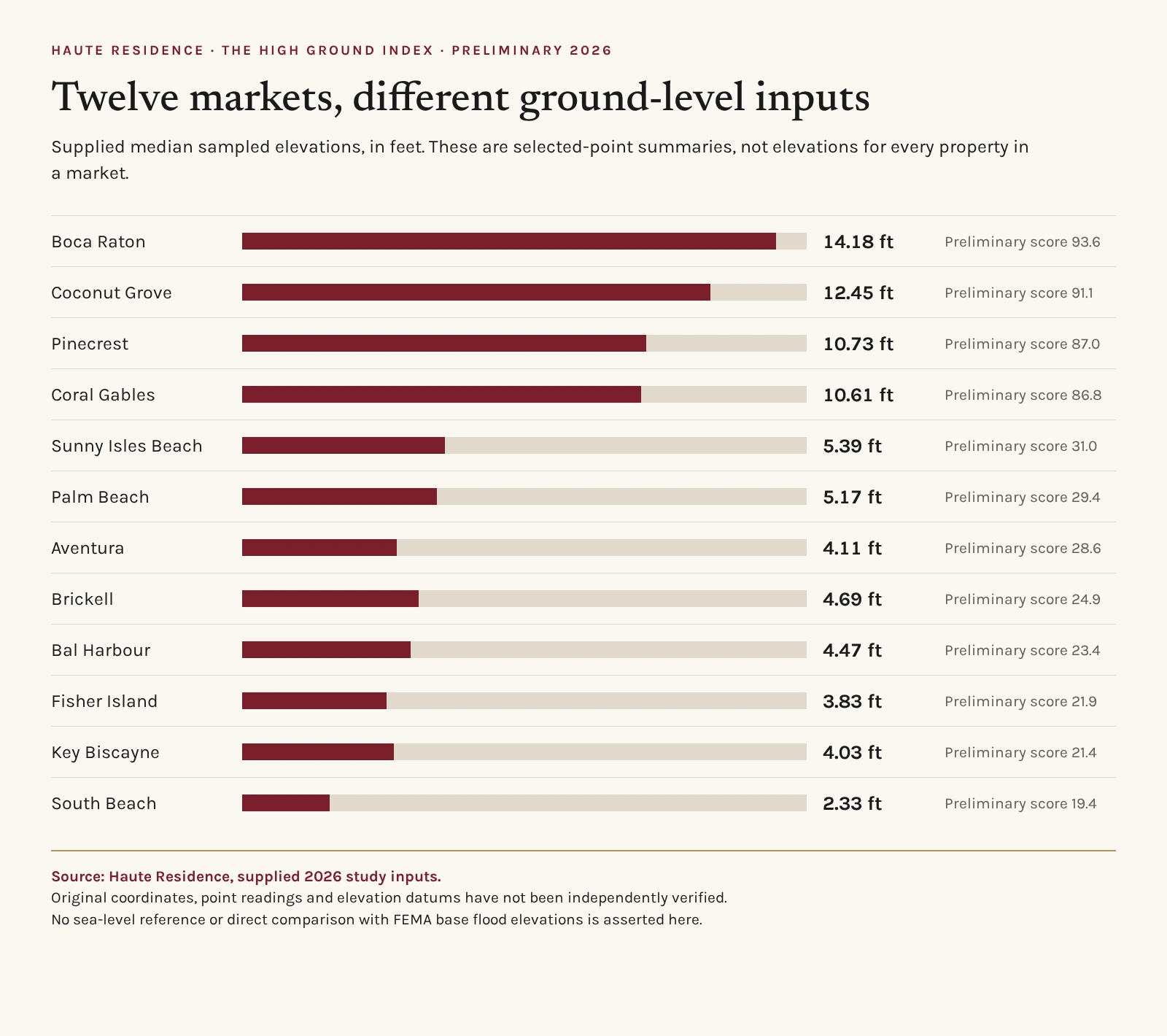
In the supplied inputs, Boca Raton has the highest score, 93.6 out of 100, alongside a median sampled elevation of 14.18 feet. South Beach has the lowest score, 19.4, alongside 2.33 feet. The ranking is a starting point for questions about a purchase, not a verdict on where to buy.
The edition is preliminary: the scores reproduce from the supplied aggregate values and formula, but the original sample coordinates, point-level readings, query dates and compatible elevation reference systems have not been independently verified. The accompanying charts have been adapted to retain that distinction.
A different lens on expensive markets
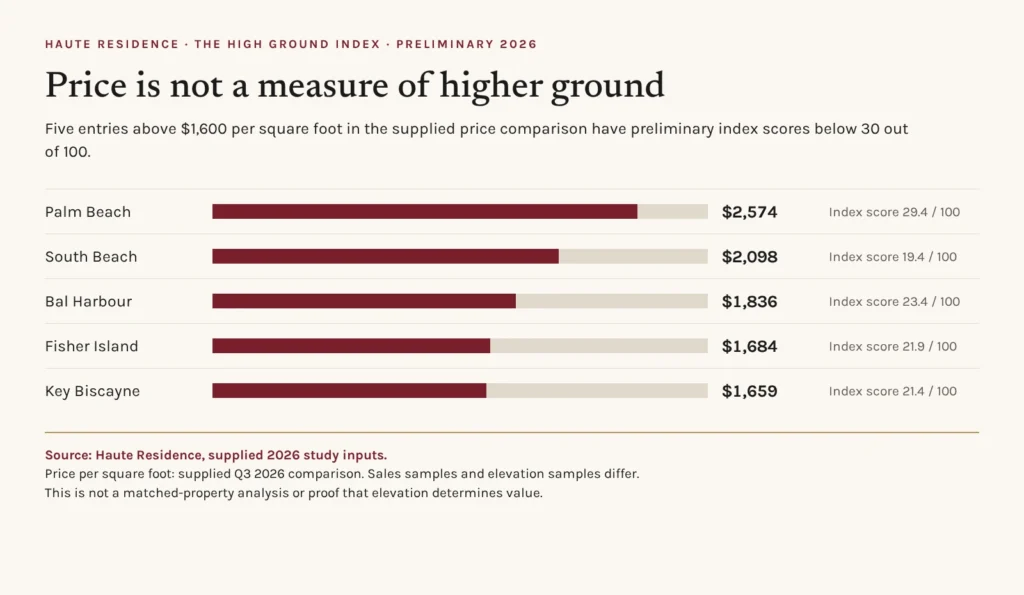
The price comparison is striking on its face. The supplied Q3 2026 figures put Palm Beach at $2,574 per square foot, South Beach at $2,098, Bal Harbour at $1,836, Fisher Island at $1,684 and Key Biscayne at $1,659. Each of those five entries has a preliminary High Ground score below 30.
That does not establish that South Florida’s most expensive properties occupy its lowest ground. The quarterly sales samples and the selected elevation points describe different populations. Location, building type, age and unit mix also matter. This comparison does not isolate an elevation discount or a waterfront premium, and it does not predict future values.
Its value to a buyer is more practical. Price is a measure of what buyers paid in a particular transaction sample. It is not a substitute for evidence about the site, the structure or the cost of insuring it.
What creates the gap in the ranking?
The top four entries are Boca Raton, Coconut Grove, Pinecrest and Coral Gables, with preliminary scores of 93.6, 91.1, 87.0 and 86.8. Sunny Isles Beach follows at 31.0. That 55.8-point gap reflects the scoring rules as well as the supplied inputs; it should not be read as a measured dividing line between safe and unsafe markets.
The formula allocates up to 35 points to sampled ground elevation, 30 to the supplied FEMA flood-zone designation, 25 to a ground-to-base-flood-elevation component and 10 to the supplied evacuation band. Where Zone X has no base flood elevation supplied, the model awards the full 25 points on that component. That is a scoring assumption, not a measurement of additional protection.
The report’s ground-to-base-flood-elevation component is not building freeboard. A building’s finished-floor elevation and the elevation standard that applies to it require their own records. Ground and flood-elevation figures also need compatible vertical reference systems before their difference can be interpreted.
What the index measures, and what it does not
The index describes selected market-level ground inputs, not the performance of a particular residence. An upper-floor condominium may sit above floodwaters while its garage, lobby, electrical equipment, pumps or access routes remain affected. A high floor does not eliminate an owner’s exposure to interruption, association costs or damage to shared infrastructure.
A higher score has limits, too. A Zone X designation does not mean a property cannot flood, and a small set of selected points cannot capture every drainage or rainfall condition across a neighborhood. FEMA flood maps and county evacuation zones answer different questions; their zone letters should not be treated as a universal cross-county risk scale.
The questions to ask before buying
Start with the address rather than the market’s rank. Request any available elevation certificate and confirm which flood map applies to the property. Have an appropriate professional distinguish ground elevation from finished-floor elevation and explain the reference system used in each document.
For a condominium, ask where the association’s critical equipment sits, how access and parking are protected, and what the building’s own records say about flood-related work. Review association insurance, deductibles and any proposed improvements alongside the unit’s coverage. The relevant evidence is the building’s documentation, not its skyline position.
Obtain an address-specific insurance quote rather than applying a county average to a luxury home. This preliminary edition does not publish the draft’s unverified insurance-premium or claims figures, and its score cannot estimate an individual owner’s bill.
The useful conclusion is not that waterfront buying is a mistake. It is that the view, the ground beneath the building and the resilience of the building itself are separate parts of the decision. Each deserves its own evidence.
Explore the research
Read all twelve preliminary rankings, the method and the limitations in the High Ground Index, or download the preliminary dataset. For transaction context, explore the Haute Residence market reports.
Sources and scope
This article draws on Haute Residence’s November 2026 preliminary High Ground Index, its supplied aggregate inputs and its accompanying price comparison, reviewed November 18, 2026. It does not report a new independent USGS, FEMA or insurance-record extraction. The report explains the intended source framework and the records still needed to validate the underlying measurements.
This is editorial research, not a property-level flood determination, valuation, insurance quote or prediction that a property will or will not flood.
Frequently asked questions
What is the High Ground Index?
It is Haute Residence’s preliminary comparison of twelve South Florida luxury markets using supplied ground-elevation, flood-zone, ground-to-base-flood-elevation and evacuation-band inputs. It scores those inputs out of 100, not the safety of a particular home.
Which market has the highest preliminary score?
Boca Raton leads the supplied ranking at 93.6 out of 100, followed by Coconut Grove at 91.1, Pinecrest at 87.0 and Coral Gables at 86.8. The original point-level measurements have not been independently verified.
Does a low score mean an upper-floor condominium is unsafe?
No. The score does not establish a building’s safety. Upper-floor homes can still be affected by disruption to shared systems, access routes and association finances, so building-specific records and insurance review remain essential.
Does the comparison prove that elevation determines price?
No. The supplied sales-price statistics and selected elevation points cover different populations. They do not isolate the effect of elevation on price or predict future values.
Explore pricing, floor plans and off-market opportunities across South Florida.
Request Pricing & Floor Plans