The number after the number: closing on new construction in Miami-Dade

The price you fell for is not the number you wire at closing. In Miami-Dade new construction, the deed tax has an official rate, a county surtax may or may not apply to your condo, and the rest is written in the offering documents. Not legal or tax advice.
You know the number by heart. It is the one on the reservation agreement, the one you said out loud at dinner, the one you moved money around for years to reach. Then, a few weeks before the keys, a closing statement arrives with lines that were never in the brochure: a state tax on the deed, title charges, a contribution to an association that does not yet have a single resident.
None of it is a trick. Most of it was in the paperwork all along. But in Miami-Dade new construction, the gap between the price and the check can be the difference between a calm closing and a scramble. Some of those lines have official rates you can check today. The rest exist only in your contract and the building’s offering documents, and that is the only place to take them from.
Rendering courtesy of the developer.
In Miami-Dade, documentary stamp tax on a deed is 60 cents per $100 of consideration, per the Florida Department of Revenue. A 45-cent county surtax does not apply to a document conveying only a single-family residence, which Florida Statutes section 201.031(1) says may be a condominium unit. Other closing charges come only from the offering documents. Not legal or tax advice.
The price you fell for is not the number you wire at closing. In Miami-Dade new construction, the deed tax has an official rate, a county surtax may or may not apply to your condo, and title charges, developer pass-throughs and capital contributions are written in the contract and the offering documents. This guide, dated November 15, 2026, walks through each line. It is not legal or tax advice, and it is not a fee schedule for any building.
Our pre-construction deposit guide covers the money you put down along the way, and our new-construction warranty guide covers what protects you after you move in. This one is about the table in between: the day the deed is about to be recorded on a new tower in Brickell or anywhere else on our Miami-Dade new-developments board.
The deed tax: one rate, and it is Miami-Dade’s own
Florida taxes the deed itself. The Florida Department of Revenue’s documentary stamp tax page, reviewed November 15, 2026, sets the rate at 70 cents on each $100, or portion thereof, of the consideration in every county except Miami-Dade. In Miami-Dade the rate is 60 cents on each $100, or portion thereof. Section 201.02(1)(a) of the Florida Statutes sets the general 70-cent deed tax. The 60-cent Miami-Dade figure in this article comes from the Department of Revenue page.
“Consideration” is broader than the sticker price. The statute says it includes money paid or agreed to be paid, and the amount of any mortgage or other encumbrance, whether or not the debt is assumed. Your closing agent confirms the taxable figure.
Who pays is a separate question. The Department of Revenue says all parties to the document are liable for the tax, regardless of which party agrees to pay it. Which of you actually writes the check is set by the purchase agreement, and a new-construction contract can allocate it differently from a resale. Read that clause before you sign, not after.
The surtax, and exactly how a condominium fits
Miami-Dade also levies a discretionary surtax of 45 cents on each $100, or portion thereof, of consideration, according to the same Department of Revenue page. That page summarizes the exception in one line: the surtax “is not due on a document that transfers only a single-family dwelling.”
The statute is more specific, and it is the line condominium buyers should read. Section 201.031(1) of the Florida Statutes allows the surtax on documents taxable under section 201.02, “except that there shall be no surtax on any document pursuant to which the interest granted, assigned, transferred, or conveyed involves only a single-family residence.” The next sentence reads: “The single-family residence may be a condominium unit, a unit held through stock ownership or membership representing a proprietary interest in a corporation owning a fee or a leasehold initially in excess of 98 years, or a detached dwelling.”
In plain terms, the statute expressly counts a condominium unit as a single-family residence for this exemption. A condominium unit is not automatically surtax-free, though. The exemption turns on the document: it applies when what the deed conveys “involves only” that one residence. The statute does not spell out how that test applies to every closing, for instance a deed that also conveys something else. Whether your deed qualifies is a question for your closing agent and a Florida attorney.
The statute’s history note also records that section 201.031 is scheduled for repeal effective October 1, 2031. For now, the surtax is on the books, and the rates above are dated November 15, 2026. Check the Department of Revenue page again if you close after a later change.
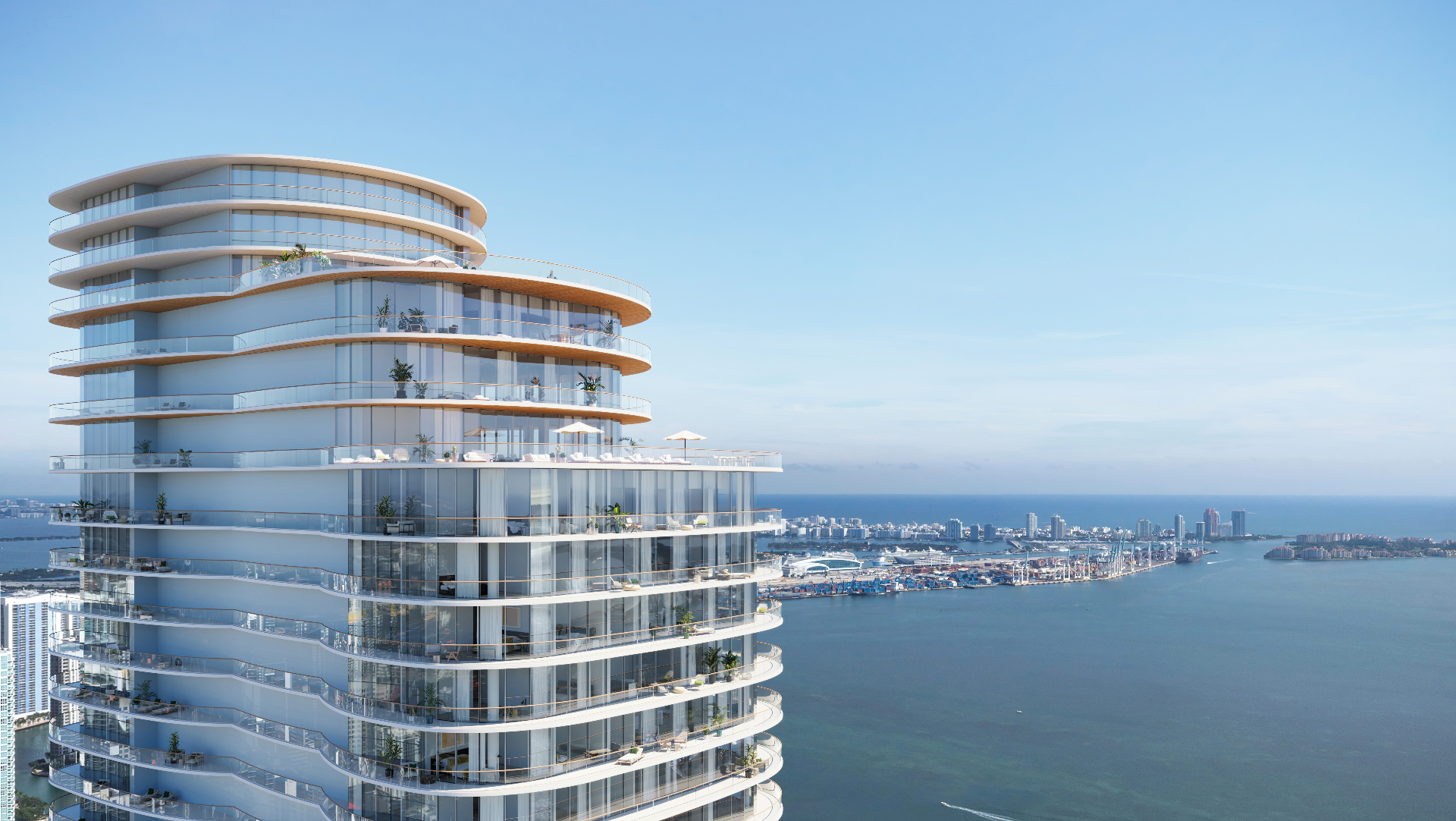
Rendering courtesy of the developer.
An illustration, and only an illustration
Illustration only. This is not a quote, an estimate for any building, or tax advice. Assume $1,000,000 of taxable consideration on a Miami-Dade deed.
- Documentary stamp tax at 60 cents per $100: $6,000.
- If the surtax applied, 45 cents per $100 would add $4,500. If the document qualifies for the single-family residence exemption, that surtax is not due.
- If you finance, the note and mortgage carry their own documentary stamp tax at 35 cents per $100, under rules on the same Department of Revenue page. Your closing agent computes it.
That is the arithmetic of the state and county lines. It says nothing about who pays them under your contract, and nothing about the lines that follow.
Title, and the lines that live in your contract
A new-construction closing statement also carries title charges: a title search, an owner’s policy, a lender’s policy if you finance, and a settlement fee. We do not publish a premium here. Ask for an estimated closing statement early and read it against the purchase agreement.
Then come the charges a developer can pass to the buyer, and this is where budgets come apart. Depending on the contract, they can include recording costs, the deed tax if the contract shifts it, association start-up items and a capital contribution. A capital contribution is typically a one-time payment to the new association at closing, sometimes framed as working capital or reserves, sometimes as a number of months of assessments. Whether it applies, how it is calculated, whether it is refundable and what it costs are set only by the purchase agreement and the offering documents: the prospectus, the declaration, the estimated operating budget and any closing-cost exhibit.
That is the rule for every tower, including the ones pictured here. We did not review offering documents for The St. Regis Residences, Miami — Brickell, Cipriani Residences Miami or Delano Residences Miami, so this article states no closing figure for any of them. If a charge is in the documents, budget it on top of the balance due after your deposits. If it is not in the documents, do not assume it.

Rendering courtesy of the developer.
Before the wire
The calm closings tend to look the same. The buyer read the closing-cost clause before signing, asked for the estimated closing statement weeks ahead rather than days, had a Florida real-estate attorney read the offering documents, and asked the closing agent one specific question: does my deed qualify for the surtax exemption? The price you fell for is still the price. It is simply not the last number on the page.
For more on the purchase itself, browse our buyer guides. This is not legal or tax advice. Take the actual numbers from the documents in front of you.
Sources
- Florida Department of Revenue, Documentary Stamp Tax page (rates, Miami-Dade surtax, liability of the parties, notes and mortgages). Reviewed November 15, 2026.
- Florida Statutes section 201.02(1)(a) and section 201.031(1), Online Sunshine, The 2026 Florida Statutes. Reviewed November 15, 2026.
Frequently asked questions
What is the documentary stamp tax on a Miami-Dade deed?
The Florida Department of Revenue sets it at 60 cents on each $100, or portion thereof, of consideration in Miami-Dade, and 70 cents in every other Florida county. Consideration includes any mortgage or encumbrance. Confirm the taxable figure with your closing agent.
Does the Miami-Dade surtax apply to a condominium?
Florida Statutes section 201.031(1) says there is no surtax on a document conveying an interest that involves only a single-family residence, and that the residence may be a condominium unit. The exemption depends on what the deed conveys, so ask your closing agent and a Florida attorney whether yours qualifies. This is not legal or tax advice.
How much is the Miami-Dade surtax?
The Department of Revenue page lists it at 45 cents on each $100, or portion thereof, of consideration, on documents that do not qualify for the single-family residence exemption. As an illustration only, that is $4,500 on $1,000,000 of consideration.
Who is liable for the documentary stamp tax?
The Department of Revenue says all parties to the document are liable, regardless of which party agrees to pay. Who actually pays is set by the purchase agreement, and a new-construction contract can allocate it differently from a resale.
What is a capital contribution at closing?
Typically a one-time payment to the new condominium association at closing, sometimes described as working capital or reserves, or as a number of months of assessments. Whether it applies, and its amount, are stated only in the offering documents and the purchase agreement.
Can a developer pass closing costs to the buyer?
Only as the purchase agreement and offering documents allow. Depending on the contract, that can include recording costs, the deed tax, association start-up items and a capital contribution. We state no per-building figures. Read the closing-cost clause before you sign.
Is this legal or tax advice?
No. It is a dated reading of official Florida rates and statutes as of November 15, 2026, and a map of lines that commonly appear at a Miami-Dade new-construction closing. Have a Florida real-estate attorney and a tax professional review your documents.